Business Thursday 29 October 2026
Oracle expands data centre footprint in UAE and Saudi Arabia amid surging AI demand
By Abu Dhabi Desk
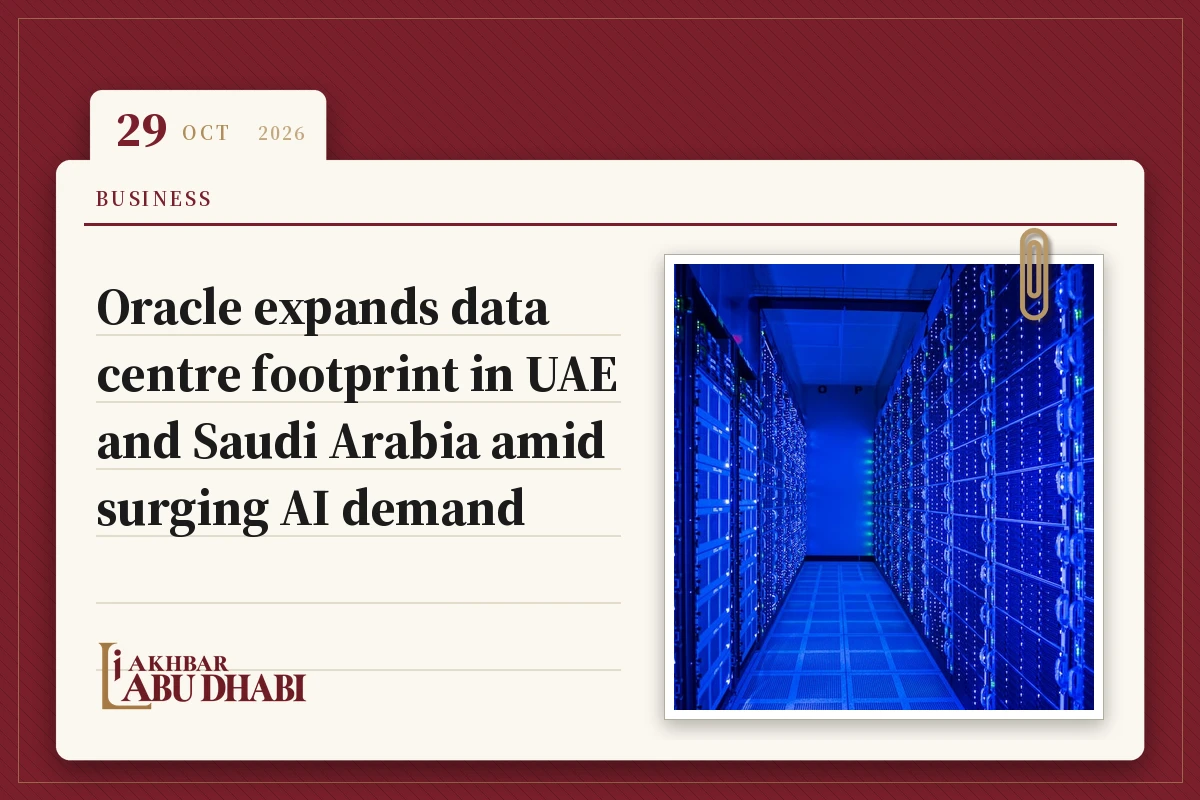
Oracle is establishing new data centres in the United Arab Emirates and Saudi Arabia in response to the growing adoption of artificial intelligence, a senior company official has said.
Cormac Watters, executive vice president of applications for Oracle Europe, Middle East, and Africa, told The National that the technology firm is increasing its data centre presence in both countries. Oracle already operates cloud regions in Dubai, Abu Dhabi, Jeddah and Riyadh, and had previously announced plans to open a facility in Saudi Arabia’s Neom megaproject.
Geopolitical concerns and sovereignty
Mr Watters declined to disclose the locations of all new data centres, citing the geopolitical environment. “We’re reluctant to explain where they all are because of the [geopolitical] situation … We don’t want any bad actors to somehow figure it out,” he said.
In March, Iran attacked Amazon data centres in the UAE and Bahrain, causing damage that the tech giant has struggled to repair. Gulf states, including Saudi Arabia and the UAE – the Arab world’s two biggest economies – faced Iranian strikes on civilian infrastructure and regional energy installations during the regional war that began on 28 February. The Gulf countries are gradually recovering, though Saudi Arabia continues to face attacks by Yemen’s Houthi rebels.
“I can tell you that we’re growing the number of data centres we have in the UAE and Saudi,” Mr Watters said. “We would have added a couple of new ones over the last six months, and there’ll be more coming in the next six months. The demand is huge, so that’s what’s driving it.”
Amid the strikes, the issue of sovereignty has become a key focus for companies in the region, Mr Watters noted. “From the business side … customers are deciding that if it’s just a normal routine purchase, they’re waiting, if it’s a strategic transformation, they’re wanting to keep going. We’re managing to work closely with them to overcome the hurdle, but it brings the first topic of conversation every single time to being sovereignty.”
A central question, he said, is where data is stored and “who has the big kill switch, or who doesn’t have the big kill switch?”
Digital embassy concept
Sovereign AI generally refers to the domestic production and deployment of AI, using local infrastructure, data, models and talent. However, Mr Watters said increased geopolitical tensions have introduced another topic into the conversation. “Because of the physical threat of a data centre being hit … they’re talking about digital embassy,” he said.
He explained that if a provider offers a sovereign cloud physically located in Abu Dhabi, for instance, there is now an option to lift that cloud and transport it physically to another country while maintaining its sovereignty – similar to a diplomatic embassy. “So, if you’re just a local data centre provider giving a sovereign solution, if there’s a genuine physical threat, it’s a challenge … To be truly sovereign, you need be local, but also have access to alternatives in the event of there being a disaster,” he said.
While such an option is currently feasible, particularly for companies with a global footprint like Oracle, regulatory considerations for certain entities, such as banks, would need to be examined and approved. “It’s very complex. Digital embassy and sovereignty is becoming the future,” Mr Watters said.
Regional growth and AI adoption
The Middle East is currently Oracle’s fastest-growing part of its wider Europe, Middle East, and Africa region. Beyond growth in the UAE and Saudi Arabia, the company sees opportunities in Qatar and Kuwait, Mr Watters said. “We have all the different types of data centres, and we’ve got different types of go-to-market [strategies]. So we will go direct, or we go with partners,” he said.
Syria is also becoming an “interesting” market in the Middle East as it opens up its economy, Mr Watters added. “But we may choose to look at that market through a distributor partnership with one of our big partners.”
Overall, Mr Watters expressed confidence that the UAE and the region will emerge as global leaders in AI. The UAE, Saudi Arabia and Qatar last year announced AI investment plans exceeding 5 per cent of GDP, amounting to about $120 billion, according to the International Monetary Fund. “I think the Middle East and UAE organisations are probably faster at adopting it [AI] than anyone else. That’s my view because they have a different mindset. They don’t have the legacy of 50-year-old systems that [they are hesitant to change]. They are used to change. They see innovation all around them every day, every month, every year … that’s not the same pace everywhere else,” Mr Watters said.