Abu Dhabi Friday 30 October 2026
ESA chief to seek deeper UAE ties on Moon missions and Earth observation
By Abu Dhabi Desk
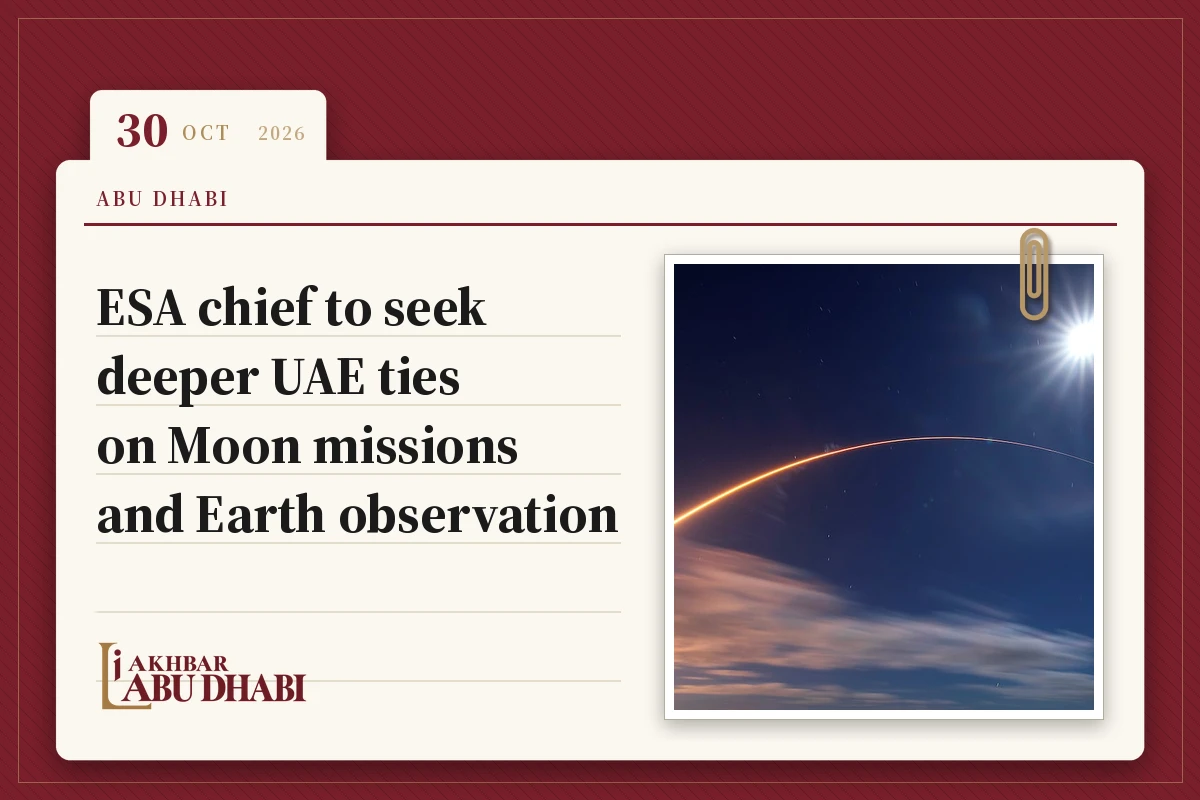
A European satellite capable of imaging below the surface has already detected ancient riverbeds and buried settlements worldwide since its launch last year. The Biomass satellite is one of the technologies that Josef Aschbacher, director general of the European Space Agency, plans to showcase during his first visit to the United Arab Emirates next week, as he pushes for closer collaboration on lunar exploration and Earth monitoring.
Aschbacher told The National that working with the UAE has become a “strategic priority” for ESA, citing the rapid expansion of Abu Dhabi’s national space programme and its private space sector. ESA, which aims to deploy research and infrastructure equipment on the Moon within the next decade, hopes to partner with the UAE’s Rashid lunar rover programme, designed to survey and analyse the lunar surface.
Such activities would help lay the groundwork for future lunar bases, Aschbacher said. “All this is being built up step by step and therefore such a lunar rover is a very important element to scope and scout what the area looks like, where to go and where to build future infrastructure,” he added. “But it’s just the beginning of more to come.”
Earth observation and lunar ambitions
The visit comes at a critical juncture for ESA. The agency has been seeking more partnerships after former US President Donald Trump pushed for cuts to Nasa’s budget, threatening transatlantic cooperation. The rapid rise of a private space exploration industry is also forcing ESA to adapt its operational model.
The UAE has set a goal of becoming one of the world’s ten leading space economies by 2031. This month, Altair-1 – the first commercial satellite built entirely in the country – was launched from Vandenberg Space Force Base in California aboard the Transporter-18 rideshare mission.
“The UAE is a very strong emerging space nation. It’s very impressive what they’ve been doing so far. This is a priority for me to really reinforce links with the UAE,” Aschbacher said.
UAE’s lunar rover programme
A key focus of the visit will be the UAE’s plan to build and launch three lunar rovers at the Mohammed bin Rashid Space Centre. The first, Rashid 1, crashed on the Moon in 2022 due to an altitude calculation error. Rashid 2 is scheduled to fly next year on the Blue Ghost II mission operated by US-based Firefly Aerospace. Rashid 3 is under construction for a 2029 launch.
Aschbacher hopes to discuss a potential trilateral mission called LUNA Bridge, which would involve a UAE rover carried by Japanese company ispace and ESA. “We have a next-generation lander that is being developed, and the joint project could be that ESA, together with the UAE and possibly Japan, could launch a mission,” he said. The lander would touch down on the lunar surface and deploy the rover, which would then perform scientific experiments. “We could test technology that is very challenging, and on the other side gain science and understand much better how the lunar surface will look like for future activities,” Aschbacher explained.
The trip will also explore opportunities for Emirati astronauts to fly alongside European ones. One possibility is joining ESA’s EPIC mission to the International Space Station, planned for 2028. ESA will charter a SpaceX Crew Dragon flight to the ISS to provide more flight opportunities for its astronauts, and non-ESA astronauts can also join the four-person crew – an offer that has been extended to Abu Dhabi, Aschbacher said.
Hazza Al Mansouri became the first Emirati in space in 2019, spending eight days on the ISS. Sultan Al Neyadi later flew aboard Crew Dragon Endeavour for a six-month stay. Two other Emirati astronauts – Nora Al Matrooshi and Mohammed Al Mulla – graduated from Nasa’s Johnson Space Centre in March 2024 and have not yet flown.
Aschbacher will meet representatives of the UAE Space Agency, the Mohammed Bin Rashid Space Centre, and several local space technology firms, including satellite communications company Space42 and infrastructure builder Orbit Works, which is collaborating with French-American firm Loft Orbital.
“The UAE has very good capacity to build up strength, capacity for its own purpose but also for export and international co-operation,” Aschbacher said.
Strategic partnership and challenges
ESA is working on its Argonaut lander project, which would transport six tonnes of equipment across four missions to help study and develop the lunar surface. The agency also plans to build a constellation of satellites around the Moon to provide navigation and communications on the surface and links back to Earth.
However, the growing competitiveness of the private space industry poses a challenge. ispace, which carried Rashid 1 on its failed first mission, also saw its second landing attempt in 2025 fail. Meanwhile, competitor Firefly Aerospace has already achieved a successful Moon landing.
Aschbacher argued that ESA’s decades of expertise in astronaut training, lunar activities and Earth observation remain unmatched. He also noted that the agency’s structure of 23 member states insulates it from political swings that affect national agencies. “Once we agree on a co-operation with another partner, this co-operation stays and is not changing with an election in one country or another country,” he said. “That means if we promise investments on our side as part of this co-operation, we always deliver.”
He insisted this holds true even with the rise of fringe politics in Europe and growing criticism of multilateral institutions. As evidence, he pointed to ESA’s record budget of €22.3 billion volunteered by member states for three years – 32 percent higher than the previous funding round.
Aschbacher envisions an “open-ended and long-term” partnership with the UAE that extends beyond a single rover project. Such a framework would see the agencies work together for at least ten years on themes like space exploration, Earth observation and telecommunications. “This is valuable and much more powerful because within this framework co-operation, you can then insert many projects that are of shorter duration and smaller scale,” he said.
He was not deterred by ongoing conflict in the Gulf, saying he had seen no indications that the UAE’s space infrastructure was at risk. “I’ve not heard or seen any of those targets to be at risk,” he said. Instead, he hopes stronger collaboration can use space technology to bolster security. “The UAE has a need to protect itself, and space is playing an important role in that. The technology that we have and can offer in such co-operations is quite of interest, from intelligence communications and many other things,” he said.