Abu Dhabi Friday 30 October 2026
UAE rocks and soil could become key resource for space exploration
By Abu Dhabi Desk
The United Arab Emirates is set to become a major supplier of rocks and soil that could be used to test spacecraft and equipment under conditions similar to those on the Moon or Mars, researchers have found.
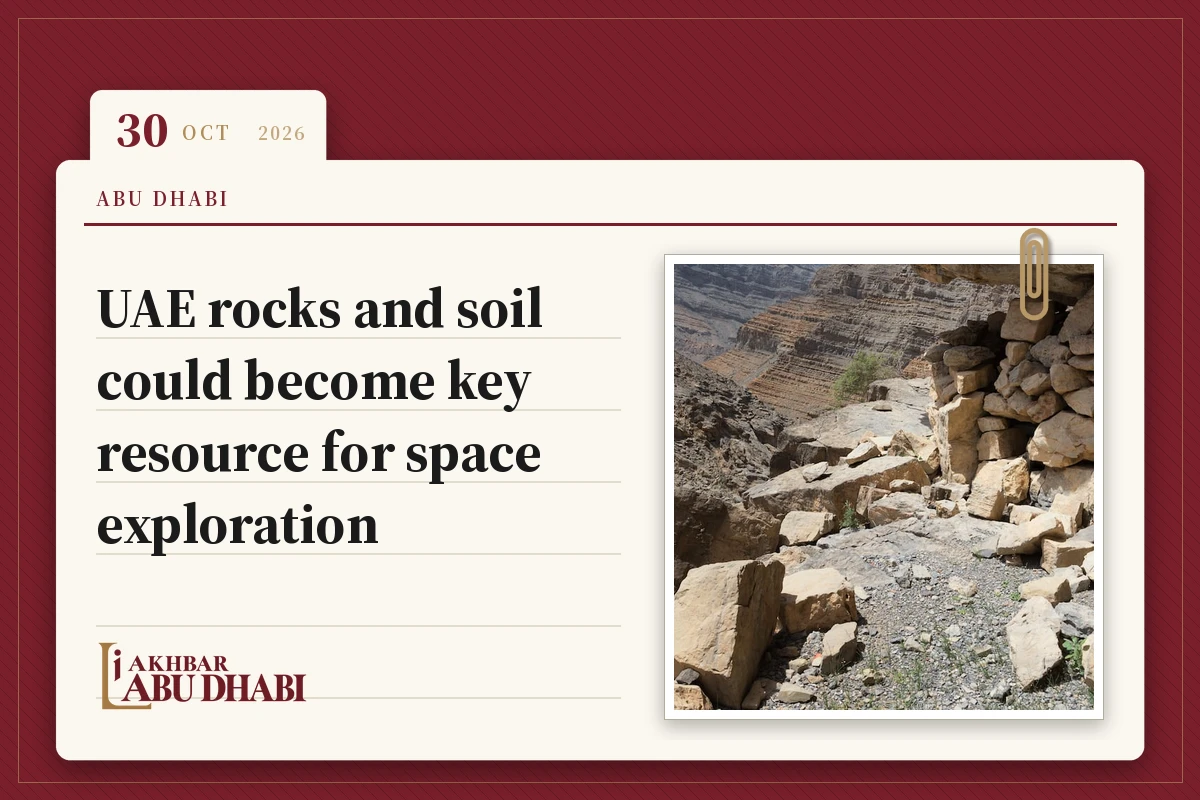
Parts of the Hajar Mountains contain geology suitable for testing rovers or drills intended for space missions, according to scientists involved in the study. Kosmas Pavlopoulos, professor of environmental geomorphology at Sorbonne University Abu Dhabi, described the results as “exceptionally promising”.
The identified areas not only contain “elevated levels” of the required minerals but are also “located conveniently near existing transport and processing infrastructure”, he told The National.
“Remote sensing data pinpointed prime extraction zones across Ras Al Khaimah, Fujairah, Ajman and Dubai,” Prof Pavlopoulos said.
Why simulants matter
Suitable rock and soil samples from Earth typically require complex processing to produce substances with properties similar to those of surface materials on other planets. These simulants can be used to test mission hardware and help scientists find ways to extract oxygen or build materials from Martian or lunar soil or rock — a critical step if human colonies are to be established on other planets.
“They are critical for space exploration because actual lunar and Martian samples collected during missions are extraordinarily rare, scientifically priceless and restricted from destructive testing,” Prof Pavlopoulos said.
Less than 400kg of material has been collected from the Moon, while no samples have ever been brought back from Mars. Meteorites from both planets have fallen to Earth.
A Japanese rocket launched in October with the aim of collecting a soil sample from Phobos, one of the moons of Mars.
NASA stated in a briefing document that “every technology being developed for use on the lunar surface needs to be tested with high-quality lunar simulants”.
Urgent demand for diverse simulants
A wide variety of simulants is needed for each planet because, for example, the Moon’s lighter highland areas differ from its darker volcanic plains. “Establishing local sources of simulants would mark a strategic breakthrough for the UAE’s space ecosystem,” Prof Pavlopoulos said.
He noted that UAE research teams “require continuous, large-scale access” to simulants as the country advances its space programmes, including the Emirates Lunar Mission, managed by the Mohammed bin Rashid Space Centre in Dubai, which involves sending rovers to explore the lunar surface. Another key programme is the Emirates Mars Mission, whose Hope probe was launched in July 2020.
A domestic simulant industry would, Prof Pavlopoulos said, cut delays in securing supplies and reduce reliance on foreign suppliers, while providing universities in the UAE with affordable bulk materials to develop “world-class testing facilities” and rover testing areas.
It would also make the UAE a “key international exporter and regional hub for planetary simulants”, he added.
“As global space activity expands exponentially, with initiatives like the Artemis programme and commercial lunar payloads, the international demand for diverse, bulk-quantity simulants is outpacing supply,” Prof Pavlopoulos said. “This reality highlights the urgent need to discover and develop scalable, domestic and regionally accessible simulant sources.”
Geological foundation
The researchers focused on the northern Hajar Mountains because the area contains the Semail Ophiolite, which Prof Pavlopoulos described as a “unique geological formation”. Stretching hundreds of kilometres, it is considered the world’s most completely exposed, largest and best-preserved section of oceanic crust and upper mantle.
This formation provides an “abundant supply” of various types of mafic rocks, rich in magnesium and iron, which are naturally rich in essential primary minerals formed from volcanic activity, Prof Pavlopoulos said.
“These are the exact mineral building blocks that dominate lunar mare basalts [dark rocks covering impact basins on the Moon] and Martian surface rocks, making the region an exceptional natural laboratory for sourcing high-grade planetary simulant feedstock,” he said.
Scientists from the University of Sharjah, Oman’s Sultan Qaboos University and the University of Lorraine in France also contributed to the discoveries, which were published in the Planetary and Space Science journal.
The published work could serve as a starting point for finding material for the space sector. “We plan to pursue follow-up work focused on the most promising regions identified in this study, subject to funding and logistical constraints,” Prof Pavlopoulos said.
Further steps will include more detailed characterisation of the material, development of “more tailored mixing recipes” to produce simulants, and a thorough evaluation of the simulants produced.
Beyond becoming a key player in space exploration, the UAE could also become an important provider of the vital materials needed to enable future missions.