Abu Dhabi Saturday 31 October 2026
Falconry season in Abu Dhabi blends tradition, camaraderie and conservation
By Abu Dhabi Desk
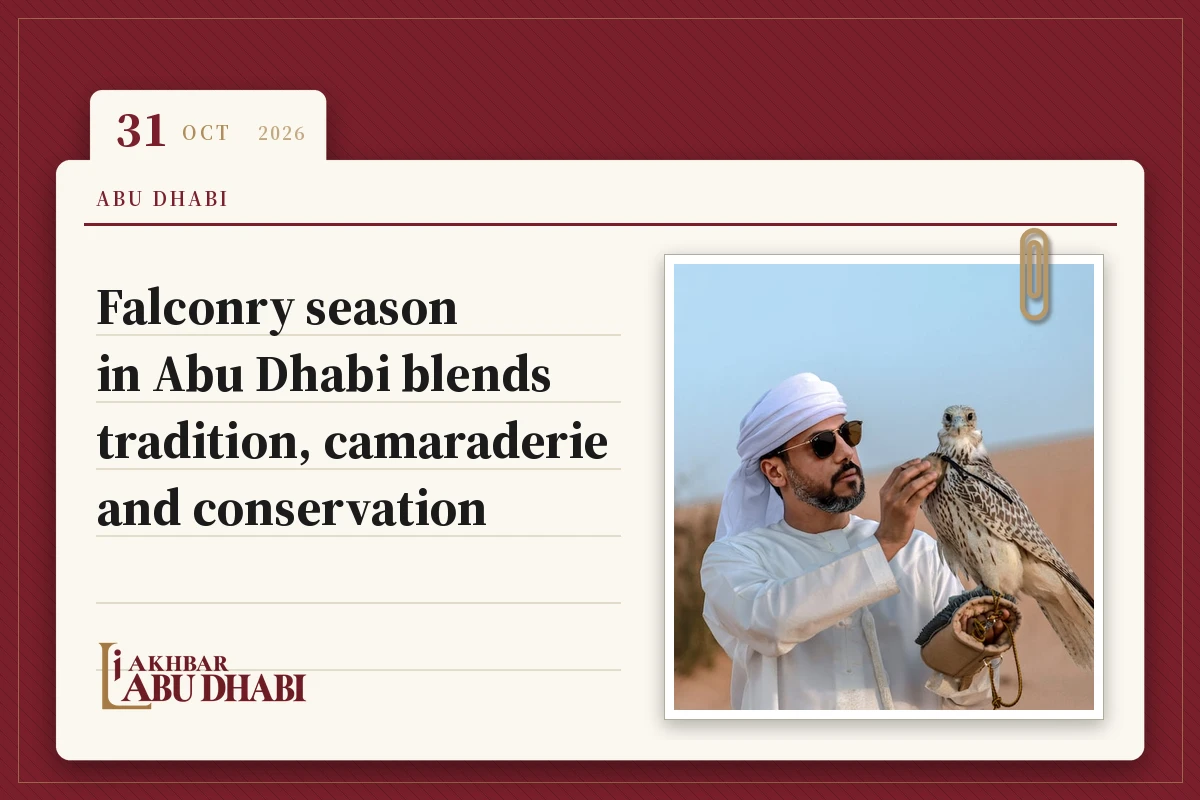
In the late afternoon, as temperatures drop over the dunes near Remah in Al Ain, Emirati falconers assemble in a traditional majlis. They drink Arabic coffee, eat fruit, and exchange stories. The atmosphere is unhurried. After prayers, as the sun starts to set, the focus shifts to the hunt.
The Environment Agency – Abu Dhabi has declared 20 October the beginning of the falconry season in the emirate, with the season continuing until 31 January.
Training and Camaraderie in the Desert
Ammar bin Humaid Al Marri, a falconer who manages the Instagram account uaefalcons, says the cooler months allow him to be in the desert daily. On this particular day, he has brought Shaman, one of his valued falcons, equipped with a GPS tracker mounted on a tail attachment.
“Each bird is trained for a particular type of prey, so you cannot simply release any falcon,” Al Marri explains. “For example, this one is released for stone-curlews, known locally as kerwan, pigeons, or birds of similar size.” Other falcons target the houbara bustard or the Arabian hare, also called the desert hare.
The current outing serves as a training session for a miqnas, a conventional multi-day hunting expedition. These trips enable the falcons to demonstrate their abilities.
Al Marri notes that the UAE has designated hunting areas within local nature reserves where hunting is straightforward. “We keep our vehicles always prepared for off-road driving, fitted for rough desert terrain,” he says. “For equipment, we require GPS transmitters for the falcons, Magellan navigation in the car, and radio frequency trackers.”
The conversation is briefly interrupted when a red stain appears on Al Marri’s kandura. The falcon, trying to fly away, has scratched his finger. Such incidents are routine, we are informed. Occasionally a falconer may forget a dead pigeon in his pocket and return home with his garment soaked in blood.
“How often we go out with the birds each season depends on divine blessing and our financial situation,” Al Marri says. “One trip per season is assured, God willing. A second outing is conditional. It might occur at the start of the season, around now or slightly earlier, and another in January or mid-January.”
Al Marri’s expression brightens as he discusses his hunting trips. For him, the experience transcends merely catching a houbara. The true value lies in connection.
“The gathering of brothers, family, and friends is what these trips are really about,” he says. “Hunting is enjoyable, and when you catch prey, you feel proud, happy, and thrilled.”
He recounts many cherished memories and relishes the camaraderie—cooking together and sharing everyday moments.
“Especially the humorous situations—like when you release your falcon after a houbara or other prey and it misses, then your friend releases their bird and catches it,” he says. “Then they tease you the entire trip and have a good laugh at your expense.”
During this training, the falcons are placed on stands called wakr within a hadhira, a circular gathering area in the sand. Two falconers stand apart—one holding the bird on his arm, the other holding a lure, known as a tilwah, made from houbara feathers to imitate prey.
The falcon is always held on the left hand, we are told, because the right hand is used for handshakes.
The falcon is released after its hood, the barka, is taken off and its legs are untied. The lure is swung in circles, and the falcon rises and dives toward the “prey”. The falconer pulls the lure away just before the bird reaches it. This creates a dance between man and bird, showcasing the falcon’s speed and strength until it eventually captures the lure.
Heritage and Conservation
Omar Humaid Al Hameli, an animal conservation specialist at the Environment Agency – Abu Dhabi, begins by removing his shoes. He advises that without doing so, one cannot truly experience the desert.
“Falconry is referenced in the Quran from over 1,400 years ago, so it is deeply embedded in Arabian heritage,” he tells The National.
“In earlier times, people would capture falcons at the start of the season and tame them to assist Bedouins in hunting prey in the desert. At the end of the season, the tamer would release the falcon to allow it to continue its migration.”
“Today, there are air-conditioned facilities where falcons are kept during the hot months until the next season.”
The timing of the season is determined by weather conditions, including rainfall, and the movements of migratory birds.
Falconry permits are issued via the Tamm app, allowing Emirati falconers to hunt only captive-bred houbara bustards during the season. Location restrictions apply; hunting is allowed in open areas at least two kilometres away from roads.
“Last season, demand for permits was extremely high, and we issued 1,525 falcon hunting permits. So far this season, we have issued 823 permits,” Al Hameli says. “We anticipate this year’s numbers will surpass last year’s, as the younger generation shows a genuine enthusiasm for this hobby.”
He states there is no worry about overhunting, even though the houbara is classified as “vulnerable” by the International Union for Conservation of Nature.
“There is no illegal overhunting because the permitted prey—the houbara—are captive-bred. Moreover, the agency has patrols deployed across all hunting locations, enabling us to maintain sustainability while preserving our heritage,” Al Hameli said.
Modernising an Ancient Practice
Saeed Suhail Al Muharrami, a resident of Remah, hails from a family of falconers. He grew up with falcons and has carried on the tradition for over 20 years, both in the UAE and abroad, including in Mauritania.
“We inherited this passion from our fathers. It has been with us since birth. It is a beautiful hobby that you naturally come to love,” Al Muharrami tells The National.
For today’s outing, he has brought his Hurr Wahsh, a wild-caught Saqer falcon renowned for its beauty and hunting skill.
“From beginning to end, the trip is pure enjoyment. We explore other countries and new hunting locations. It is a wonderful journey—a combination of travel and hunting,” he says.
Al Marri also travels abroad with his falcons, which requires preparation, including obtaining falcon passports. The birds travel in the aircraft cabin alongside the falconers.
“Each country has its own conditions or restrictions on which prey may be hunted, what is prohibited, or quotas for certain game,” he says.
Al Muharrami notes that technology has made falconry significantly easier, from air conditioning to keep birds cool to permits being swiftly obtainable via a mobile phone.
“There is a big difference. Today, science has advanced, tracking devices are available, and facilities and access have improved,” he says. “Each year is better than the previous. Any minor problems from before are resolved for the new season.”
The worth of a falcon extends beyond prestige or monetary value, although prized birds can be worth over one million dirhams.
“There is a well-known proverb: ‘He who does not know the falcon roasts it,'” he says.