Business Thursday 29 October 2026
Abu Dhabi pipe maker sees boom as Gulf states bypass Hormuz
By Abu Dhabi Desk
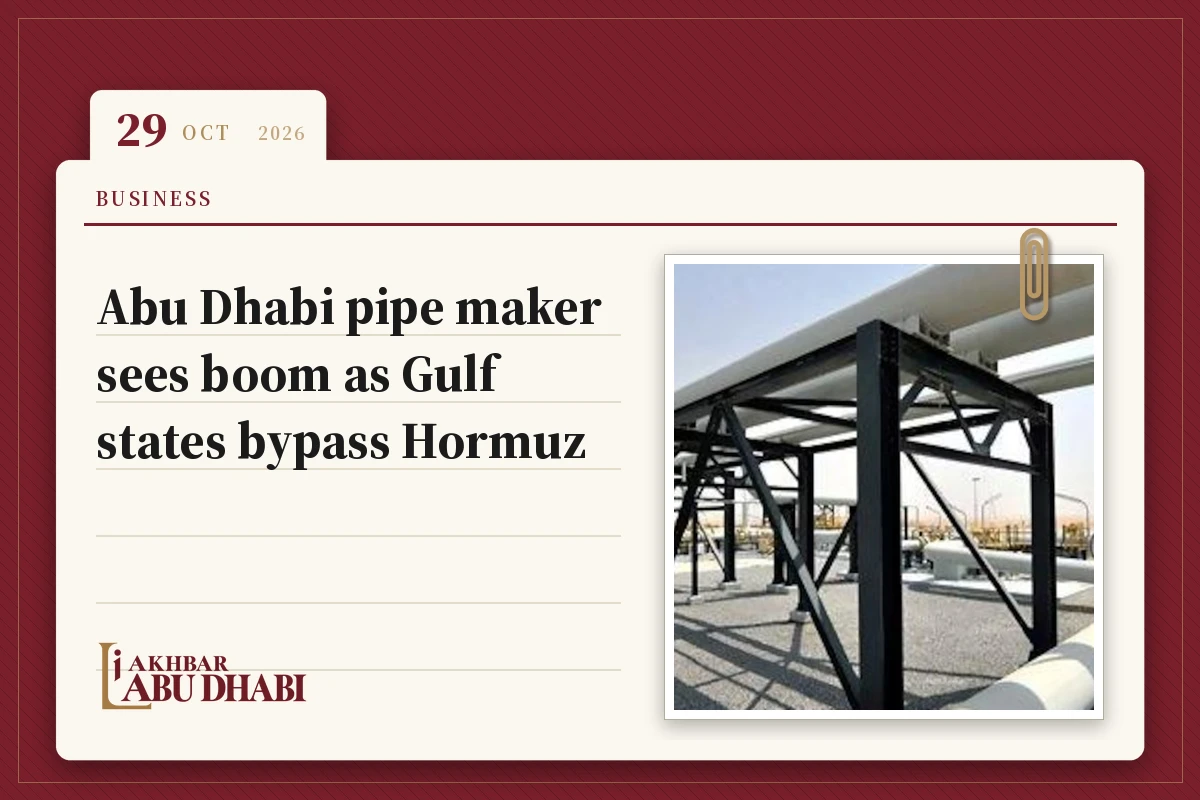
Abu Dhabi’s Al Gharbia Pipe Company is poised to benefit from a wave of new pipeline projects across the Middle East as countries seek alternatives to the Strait of Hormuz, which remains effectively shut due to the war with Iran.
Noritsugu Mifune, acting chief executive of the joint venture between Abu Dhabi’s Senaat, Japan’s JFE Steel and Marubeni-Itochu Steel, said the company expects a significant increase in orders for pipes used to transport oil and gas over long distances.
“Every country in the region is considering a new pipeline to avoid Hormuz. We expect more demand in future,” he told The National.
Pipeline projects accelerate
Gulf nations and Iraq have announced plans to build crude pipelines to global markets as shipping through the strait remains disrupted.
The UAE is expanding the 360km Habshan–Fujairah pipeline, also known as the West–East crude oil pipeline, aiming to double its export capacity from the current 1.5 million barrels per day. Iraq and Syria are collaborating to revive a pipeline damaged during the 2003 US-led invasion.
Saudi Arabia, the largest oil producer in Opec, is also studying an expansion of its East-West pipeline to supply world markets without transiting the Strait of Hormuz.
Last month, US Treasury Secretary Scott Bessent predicted that the strait “will be a worthless piece of water” in two years, once new pipelines allow Gulf countries to bypass it. He estimated that up to 70 per cent of the energy that typically passed through the waterway would shift to pipelines.
Past projects and future outlook
Al Gharbia has previously supplied pipes for Adnoc’s West–East crude pipeline and for Iraq’s Majnoon oilfield near Basra, Mr Mifune said. The company is currently in discussions with Adnoc about future pipeline projects, he added.
The firm is also exploring the manufacture of pipes for hydrogen transport, as countries ramp up production of the low-carbon fuel to reduce emissions.
Al Gharbia’s pipe production reached about 250,000 tonnes last year but fell to roughly 60,000 tonnes this year due to supply chain disruptions and delays to oil and gas projects across the region caused by the war. The company expects to increase output to 200,000 tonnes next year in anticipation of higher demand.
Supply chain and shipping
The company imports steel plates from Europe, China, South Korea and Japan, with Fujairah port playing a key role for shipments since the strait’s closure.
Junya Kako, chief commercial officer, told a media round-table in Abu Dhabi on Wednesday that a vessel carrying steel for the company has crossed the Strait of Hormuz, the first such shipment since the conflict began.