Business Wednesday 28 October 2026
Blackstone eyes fourfold Gulf asset growth despite regional conflict, CEO says
By Abu Dhabi Desk
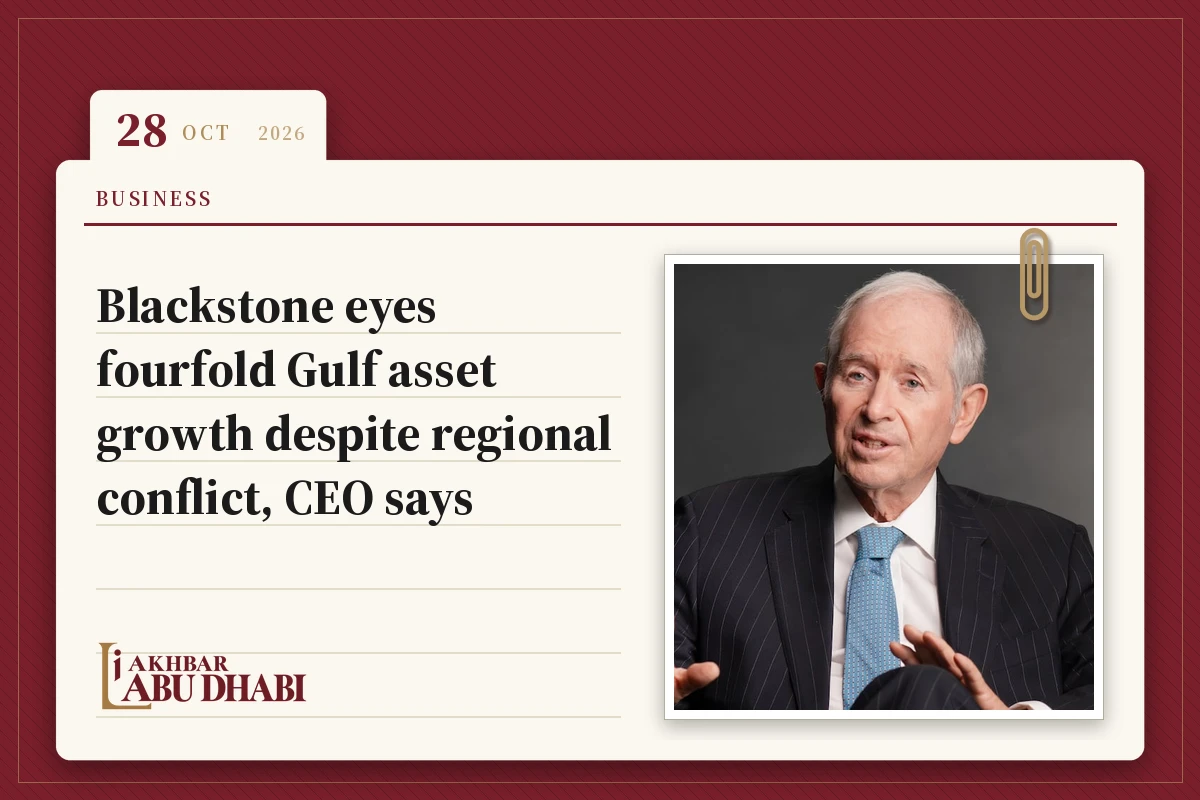
Blackstone has deployed more capital into the Gulf over the past year than at any other period in its history, and intends to continue investing even as geopolitical tensions persist, according to its chief executive.
Steve Schwarzman, who also serves as chairman and co-founder of the world’s largest alternative asset manager, told The National that the region’s investment appeal remains strong despite the ongoing conflict.
The $1.3 trillion firm aims to significantly increase the share of its assets under management in the Gulf within its broader Europe, Middle East and Africa portfolio by the end of this decade.
“I would say it would surprise me if it weren’t three to four times larger from the current level,” Schwarzman said, declining to give a dollar figure.
Last year he noted that the company’s combined asset base in Europe and the Middle East had reached $400 billion, and that there was potential to grow that to $500 billion in Europe alone by 2035.
Deal-making surge
Blackstone, which has operated in the Gulf for more than 15 years, has accelerated its investment pace in the region over the past 12 months through a series of transactions.
In July last year the firm invested $16 billion, alongside global partners, in the Kuwait Oil Company’s crude oil pipeline network. In March last year it announced a $250 million allocation to Abu Dhabi’s Advanced Digital Gaming Technology.
In April it formed a partnership with Dubai Aerospace Enterprise to invest roughly $1.6 billion annually in aircraft leasing.
The $16 billion Kuwait deal highlights the company’s growth ambitions in the region, Schwarzman said.
Global investors like Blackstone have traditionally focused on raising capital from the Gulf, but are now shifting toward investing directly, competing for opportunities in digital infrastructure, technology, real estate and energy.
The Gulf’s role as a capital exporter is reversing as its own financing needs rise rapidly, Schwarzman said.
“That has to do with the maturity of the region and people look at it and say, ‘there’s something going on here’ [and] that is changing the way we’re looking at this region,” he said.
In October last year Blackstone launched Glide, a $5 billion logistics platform, together with Abu Dhabi’s Lunate. A month earlier it had taken part in a $525 million financing round for UAE property portal Property Finder.
Blackstone, which manages over $200 billion in data centre and AI-related infrastructure, has also expanded its technology investment footprint in the Gulf.
Its portfolio company AirTrunk struck a $3 billion data centre deal with Saudi Arabia’s Humain, which Schwarzman said could be the first of many such deals elsewhere in the region, including the UAE.
“There are opportunities to collaborate with what’s going on in Abu Dhabi, which in AI, is the most progressive, most informed, most advanced,” he said.
“It also has the advantage of nuclear power and it’s pretty remarkable all the things that are being done in Abu Dhabi.”
Global investors who visit the region can see changes that are “really fascinating”, he added, and once the Gulf reaches critical mass, “all of a sudden it becomes really interesting”.
Expanding regional presence
Blackstone, which opened its first Abu Dhabi office in 2010, is rapidly growing its regional footprint.
The company has broadened the scope of its Abu Dhabi licence, opened an office in Kuwait and is about to formally launch dedicated private wealth operations in Dubai.
“We’re going to have offices, in pretty much every country,” Schwarzman said.
“We expect to be over time putting more capital in the region from a global perspective, because you tend to make more money in our lines of business, where there’s rapid economic growth.”
Conflict headwinds and infrastructure boom
Blackstone, like its global peers, remains undeterred despite the eight-month-old Iran conflict.
“It obviously changes the risk profile of the region, but we’re longer-term investors, and I think the people who deal with the region, who provide capital, realise that there are very smart people running these countries,” Schwarzman said.
Regional sovereigns are willing to spend whatever is needed to expand infrastructure, which will trigger a new construction boom once the conflict ends, he said.
“From talking with the heads of these countries, it’s pretty clear they’re going to spend whatever it takes to create a much safer environment, for their long-term economic plans,” Schwarzman said.
“The commitment to engineering safety and to protect their infrastructure over the next two to three years is going to be a very intense period, and so in that sense, they’ll rebuild their economies.”
The US-Iran war has severely disrupted economic momentum in the Gulf, with the International Monetary Fund estimating a 4.8 per cent contraction in 2026 and a 9.1 per cent rebound in 2027.
“But what’s interesting, beyond that, is that it is temporary and we expect all of the Gulf to go into rapid growth mode once this conflict is resolved,” Schwarzman said.
The push to protect and expand infrastructure will be among the main drivers of the next phase of economic activity, he said.
“One of the things that’s going to happen in the Gulf, that’s probably been underestimated, is the amount of spending to protect the infrastructure,” Schwarzman said.
Blackstone expects a “very substantial construction boom” as Gulf countries move vulnerable infrastructure underground.
Gulf nations will need to rebuild their economies if Iran remains “a structural problem” for years to come, Schwarzman said.
“I’m not enough of an expert to know what the response will be, but there are a lot of different scenarios that you could have, and it strikes me that just being a recipient of that aggression forever is an unlikely scenario.”
The broader Middle East and North Africa region currently requires an estimated $900 billion in infrastructure financing. British lender HSBC estimates the finance pipeline in the UAE alone is over $190 billion, about 22 per cent of the regional total.
A report released last week by HSBC identified $872 billion worth of individual project packages within a wider $1.4 trillion pipeline of planned and unawarded infrastructure projects.
“I can speak for us, but I don’t think others like us are particularly different, and we see this as a very good long-term place for growth,” Schwarzman said.