Abu Dhabi Tuesday 27 October 2026
Stranded astronaut Sunita Williams praises UAE space ambitions at Abu Dhabi symposium
By Abu Dhabi Desk
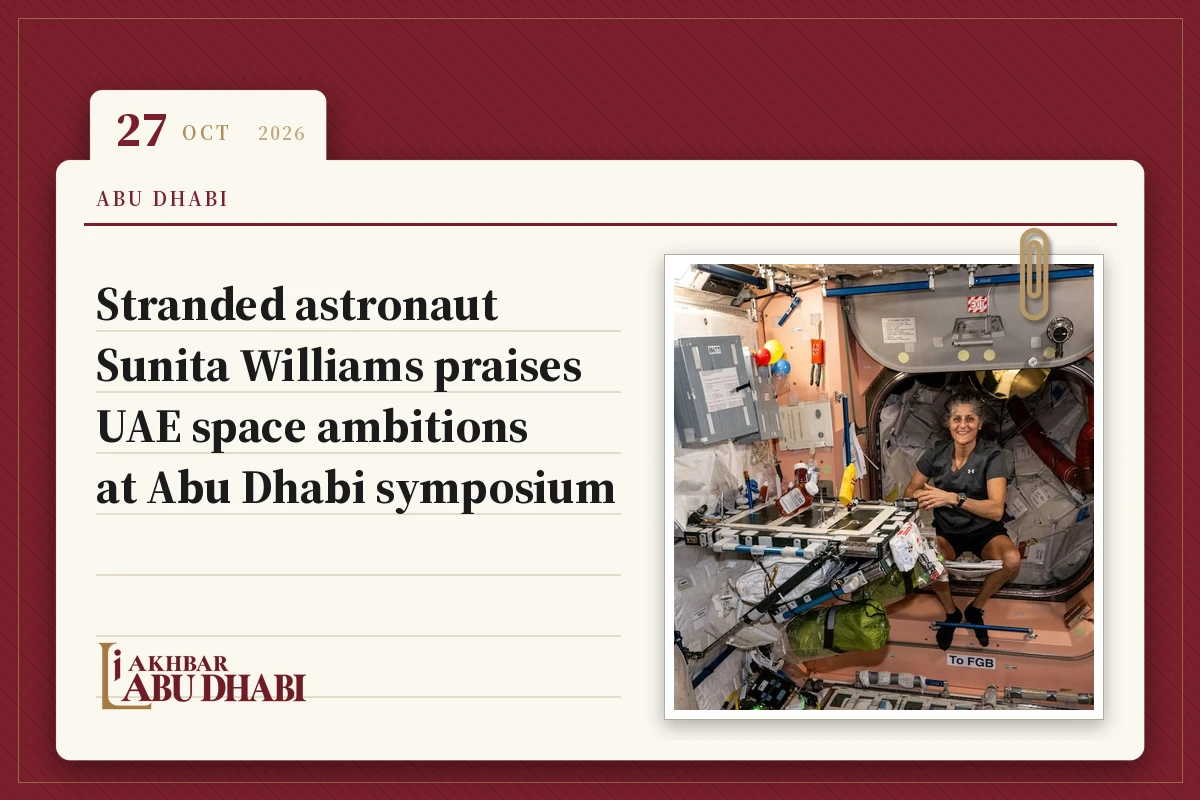
Indian-American astronaut Sunita Williams has commended the United Arab Emirates’ dedication to space exploration, sharing her experience after being stranded aboard the International Space Station for nine months.
“The UAE is already committed to having astronauts fly in space,” Williams said during an event in Abu Dhabi on Tuesday.
The nation’s goal of becoming a leading spacefaring country was evident, she added, along with its willingness to collaborate internationally on scientific discoveries.
Nine-month stay on ISS
Williams, aged 61, has accumulated 608 days in space over her 27-year career, giving her a distinctive perspective on the sector.
What was planned as an eight-day test flight in 2024 turned into a 286-day stay for Williams after the Boeing Starliner spacecraft suffered technical problems and was returned to Earth without a crew.
“Getting used to gravity is tough. This time, I was about 10 years older than when I flew last time and it took quite an adjustment,” Williams told The National.
Recovery from that mission also took longer, nearly two years compared to the one year it required after her previous space flight.
“I could definitely tell this time it took a little bit of a toll on me, but I’m finally feeling like I’m getting the speed. I’m back, I can’t escape gravity,” she said at the UAE Space Biotech and Low Earth Orbit Commercialisation Symposium in Masdar City.
“This is a new chapter,” said Williams, who now serves as an astronaut adviser at commercial space company Vast. “Of course, I’d like to fly again. But that’s not my role right now. My role is to help start these companies up and get things going.”
Vast, a US space infrastructure company founded in 2021, aims to offer commercial alternatives to the International Space Station, which is scheduled to be retired in 2030 or 2031. The company’s first space station, Haven-1, is set to launch in early 2027.
UAE’s expanding role
The UAE’s influence on the space sector will only increase with the progress made by commercial firms, according to one expert.
“As commercial stations emerge, the UAE has an opportunity to help shape the future of research,” said Salem Al Qubaisi, director general of the UAE Space Agency.
“Our strategy promotes international partnership, reciprocal access to facilities and joint missions. Our focus must remain on clear solutions for Earth, not only space.”
Space exploration depends on global cooperation, said Mohammed Al Mulla, a former Dubai Police pilot selected in 2021 for the UAE’s astronaut programme. “We learnt that we need to go to space together. It’s never been someone or a country by itself,” Al Mulla said at the event.
“It’s all about collaboration … and nowadays, the private sector is doing a great job pushing space technology even further and faster so that it will be a huge collaboration in the future.”
The UAE’s National Space Strategy 2031 aims to integrate research, industry and investment so that national companies can contribute to developing and manufacturing advanced space technologies. The country also aspires to be among the world’s top 10 space economies by 2031.
This month, the first commercial satellite built entirely in the UAE was launched, hailed as a major step forward in the nation’s quest to become a global leader in space. Altair-1, designed, assembled and tested in Abu Dhabi, lifted off from Vandenberg Space Force Base in California aboard the Transporter-18 rideshare mission.
In May, Sheikh Hamdan bin Mohammed, Crown Prince of Dubai, Deputy Prime Minister and Minister of Defence, unveiled a Dh1 billion (USD 272.2 million) strategy to boost the UAE’s role in the space sector. Sheikh Hamdan said the International Space Co-operation Programme would support the country’s mission to solidify its growing status as a major player in the booming industry.