Abu Dhabi Thursday 22 October 2026
Two UAE researchers among six Arab women awarded L’Oreal-Unesco science grants
By Abu Dhabi Desk
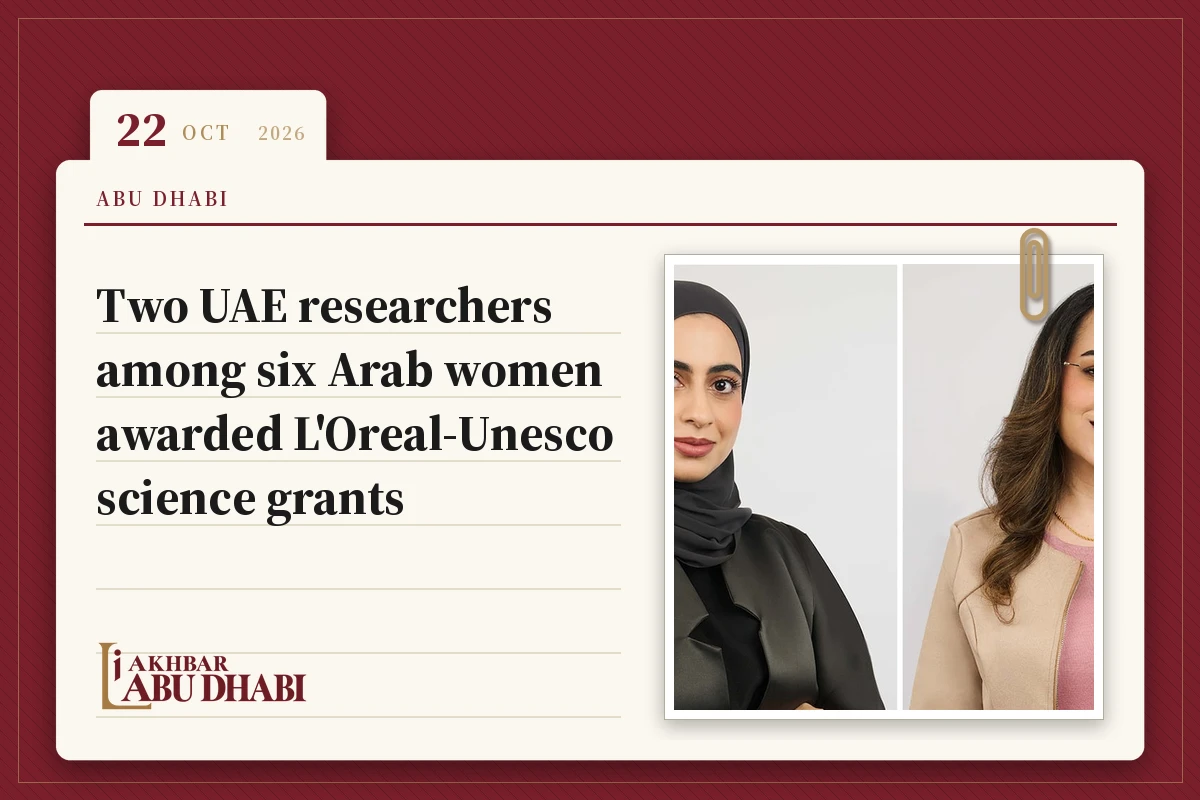
A programme supporting women scientists in the Arab world has selected two researchers from the UAE for grants, marking the latest round of an initiative that has now backed 69 female scientists across the region.
The L’Oreal-Unesco For Women in Science Middle East Programme awarded Dr Marieh Al Handawi of New York University Abu Dhabi and Jawaher Al Hammadi of Khalifa University in its 2026 edition. They are among six female researchers from the Arab world recognised in this cycle, whose work spans pandemic preparedness, water security and personalised medicine.
Cell membrane models for personalised treatment
Ms Al Hammadi, an Emirati PhD student from Sharjah who grew up in Abu Dhabi, focuses on laboratory-based models of cell membranes. She told The National that the recognition offered “a valuable opportunity to increase the visibility of my research”, as well as to build international connections and foster potential collaborations.
“I think these opportunities are incredibly important especially for young researchers, because science thrives when we exchange knowledge and learn from one another,” she said.
Her research aims to develop customisable cell membrane models that could enable testing of personalised treatments for patients. “The cell membrane surrounds every cell in our body and plays an essential role in how cells communicate, recognise signals, and respond to their surroundings,” she explained. “By recreating these membranes in the laboratory, we can study these interactions in a more controlled environment.”
Conventional cell membrane models are often made from synthetic materials, which, Ms Al Hammadi noted, cannot fully replicate the complexity of real cell membranes. “To address this, I combine synthetic components with tiny particles derived from cells, known as extracellular vesicles, which carry characteristics of the cells they originate from,” she said. “I then integrate these membranes with electronic sensors that allow us to detect and monitor changes in the membrane through electrical signals. Ultimately, my goal is to develop a technology that can help researchers better understand diseases and evaluate how cells respond to different treatments.”
With her method, she said, it may be possible to recreate cell membranes representing specific cell types, diseases or even individual patients. She described it as “a very exciting time” to be a woman working in her field in the UAE, adding that the country “places great importance on science, innovation and empowering women”. “Over the years we have seen more women entering Stem fields, taking on leadership positions, and making important contributions to scientific research, and that is something I am very proud to witness,” she said.
Growing numbers of women in science
Since its launch in 2014, the L’Oreal-Unesco For Women in Science Middle East Programme has supported 69 female scientists, including 25 in the UAE. The programme has awarded a total of Dh4 million to support research in the region. Six women from the Arabian Peninsula were recognised in the latest edition.
According to Unesco, women make up 41 per cent of scientists in the Arab world, a share surpassed only by Central Asia (50 per cent) and Latin America and the Caribbean (44 per cent). By comparison, the figure is 27 per cent in East Asia and the Pacific, 32 per cent in sub-Saharan Africa and 34 per cent in western Europe.
Water harvesting from desert plants
Dr Al Handawi, a Syrian born and raised in the UAE, joined NYU Abu Dhabi after completing master’s and doctoral degrees at NYU in New York. She studies how plants adapt to salty and dry conditions, hoping to uncover ways for people to extract water from their environment. Among the plants she has analysed is the native tree Tamarix aphylla, which lives in salty sabkha habitats. The plant excretes a salt solution that evaporates, forming salt crystals.
“These crystals act as magnets, capturing moisture directly from the air, even at relatively low humidity and condensing it on the plant,” she said. “This showed me that desert plants can provide us with natural solutions to the same problems we are trying to solve: how to access and manage water under extremely dry and challenging conditions. My research explores whether we can use the significant amount of water already present in the UAE’s atmosphere as humidity and extract it with much lower energy requirements.”
She said many more plants in the region remain to be studied that “may offer completely different strategies for water harvesting”. Ultimately, she aims to establish an independent research programme focused on “bioinspiration” – learning from natural systems, especially those adapted to the Middle East’s harsh environments – and translating those mechanisms into practical solutions. “I want my research to go beyond discovery and ultimately lead to materials and technologies that can be tested and used to support communities,” she said.
Official support for women researchers
Sarah Al Amiri, Minister of Education, said in a statement that women in the UAE were “playing an increasingly prominent role in research” and in fields including advanced technology, health care, sustainability and aerospace. “Our focus is on strengthening the journey from education to research, and from research to real-world impact, so that young people have the skills, confidence, mentorship and opportunities to shape the future,” she said. “The L’Oreal-Unesco For Women in Science Middle East Programme advances this ambition by recognising women researchers, supporting their careers and giving the next generation visible examples of what scientific leadership can achieve.”
Other programme recipients include Alaa Al Mushaikeh, a Saudi physicist at King Abdullah University of Science and Technology (Kaust), and Hadeel Zedan of Qatar University, who researches antiviral medications against coronaviruses and other viruses. Also awarded were Dr Aljawharah Al Rubayyi, a Syrian scientist at Kaust working on vaccines and immunotherapies, and Dr Sara Al Araimi, who studies ways to turn waste into water and useful materials at Oman’s University of Technology and Applied Sciences.
Laurent Duffier, managing director of L’Oreal Middle East, described the scientific talent emerging across the region as “remarkable”. “Women are increasingly at the heart of that progress,” he said. “Our responsibility is not only to recognise that talent, but to help create the visibility, networks and opportunities that allow it to thrive.”