Business Friday 23 October 2026
UAE petrol prices expected to rise again in November as oil market uncertainty persists
By Abu Dhabi Desk
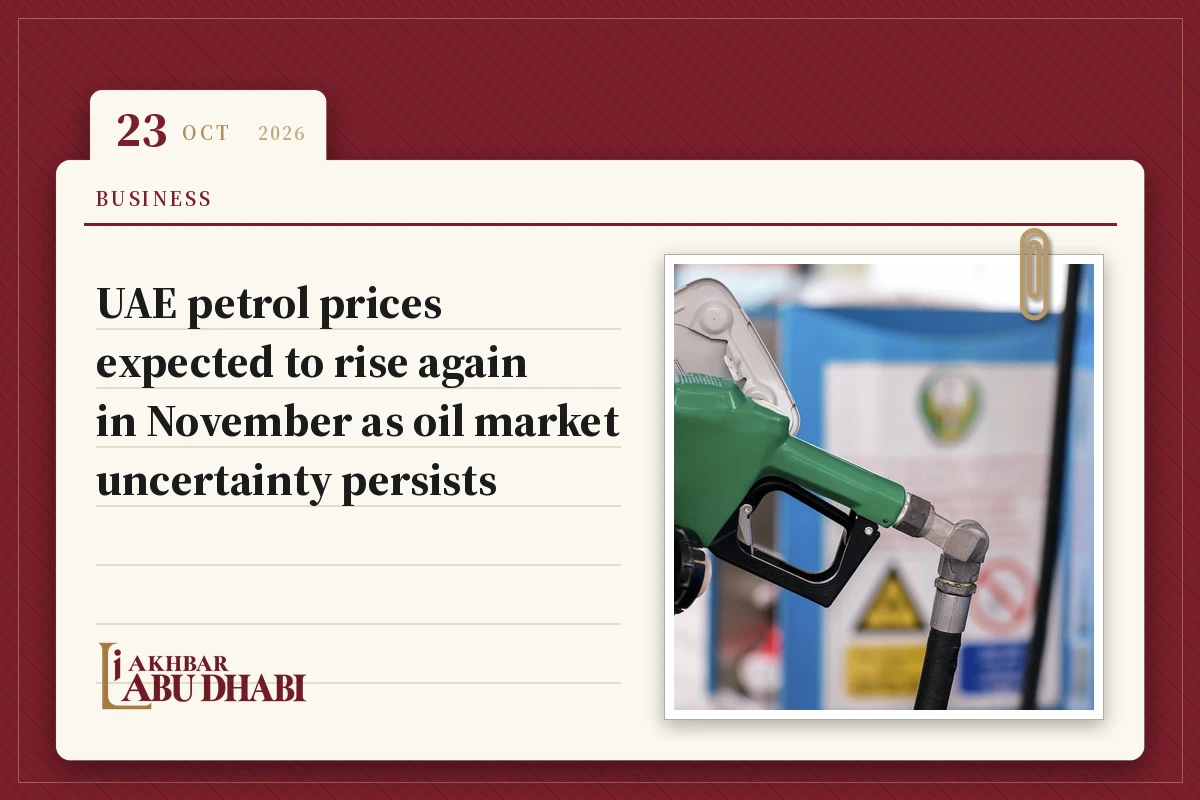
Petrol prices in the UAE are likely to increase for a fourth consecutive month in November, as the gradual recovery of Middle East oil supplies has not yet restored stability to the global energy market, analysts said.
October already saw a third straight monthly rise at the pumps, driven by persistent uncertainty over a possible truce between the United States and Iran.
Oil prices surged this month after Yemen’s Houthi rebels, who are aligned with Iran, escalated their attacks on Saudi Arabia, pushing crude to its highest level in five months.
On Friday, Brent crude traded near $115, gaining 1.32 percent to reach $114.70 per barrel at 2:59 PM UAE time. West Texas Intermediate rose 1.57 percent to $101.10 per barrel.
Risk of another increase
With Brent exceeding its September peak this month, “the risk of another increase in UAE petrol prices for November is elevated,” said Jordan Lawrence, chief executive and co-founder of Damisa, a London-based financial services firm.
“October’s fuel rates already rose significantly, and the committee’s end-of-month review will reflect the full month’s international averages, refined-product prices and costs,” Mr Lawrence told The National.
Ship tracking data shows that oil movements through the Strait of Hormuz, which before the conflict accounted for one-fifth of the world’s energy exports, are slowly picking up.
US Energy Secretary Chris Wright said last week that up to 14 million barrels of oil per day were transiting the strait, with Gulf crude flows recovering to between 80 and 90 percent of prewar levels.
Recovery does not equal normalcy
However, the recovery in Middle East oil exports during October does not automatically mean the market has returned to normal, according to George Pavel, general manager at Naga.com Middle East, a capital markets firm operating in Abu Dhabi’s ADGM.
“Ongoing threats to shipping and persistent uncertainty around the Strait of Hormuz continue to support prices. The key change is that the market is increasingly pricing the risk of further disruptions, instead of simply assessing current production and export volumes,” he told The National.
“Even when supply flows recover, the cost and reliability of transporting crude remain important constraints … if exports remain resilient and diplomatic progress reduces the threat to shipping, prices could retreat quickly.”
“The next decisive factor will be whether October’s security risks translate into lasting physical supply losses.”
Geopolitical premium persists
Ahmad Assiri, a research strategist at financial services firm Pepperstone, noted that even if barrels continue to reach markets via the Strait of Hormuz, uncertainty about the reliability of future deliveries gives buyers a reason to pay a significant premium for now.
“Many buyers have become price-insensitive due to elevated uncertainty … a diplomatic breakthrough could provide some ease and a pullback,” he told The National.
“However, a sustained decline would require confidence that infrastructure and shipping routes can operate securely, which is a hard thing to see in the current environment,” he said.
“October has strengthened the conviction that the geopolitical premium will be persistent, and this in turn makes the eventual growth and inflation consequences more concerning.”