Business Wednesday 21 October 2026
Whoop CEO says Abu Dhabi is a launchpad for predictive healthcare shift
By Abu Dhabi Desk
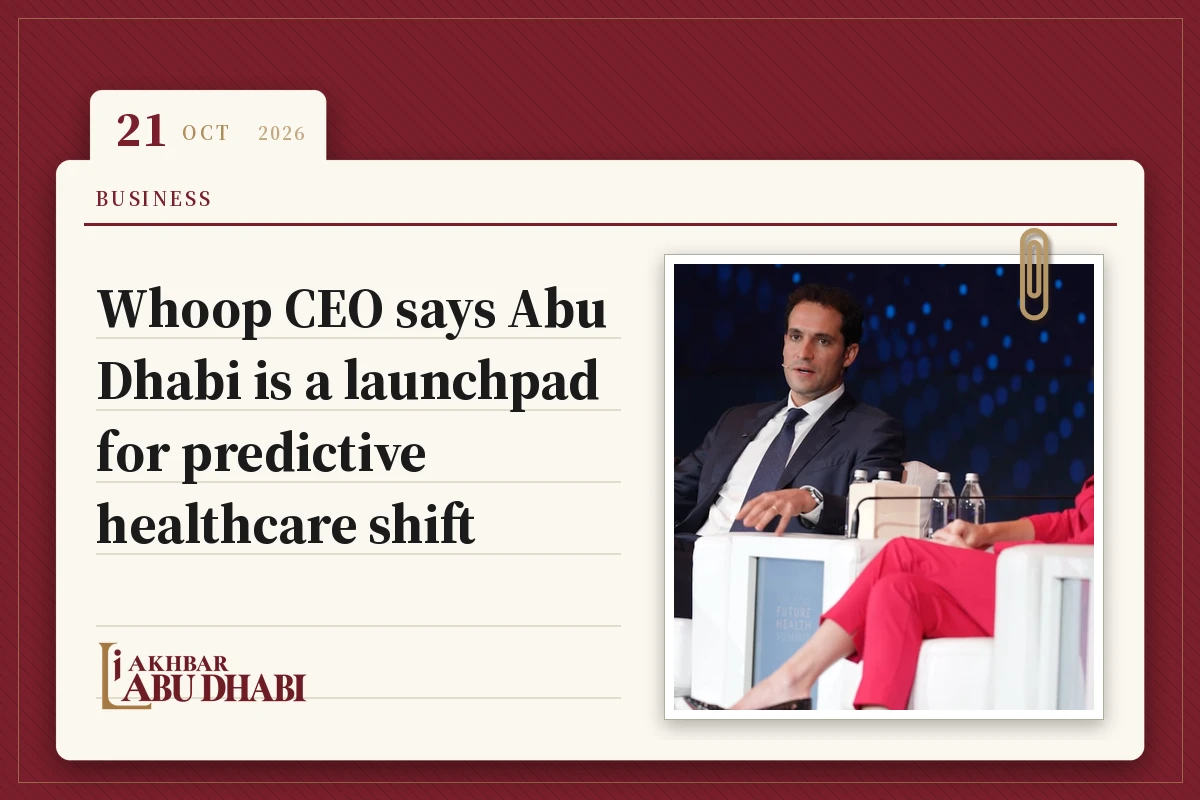
The US-based human performance company Whoop is expanding its presence in the Gulf region’s growing longevity sector.
This week, Whoop unveiled a clinical research agreement with the Abu Dhabi Department of Health. The partnership follows a $75 million cornerstone investment from Mubadala Investment Company and a wider expansion that has turned the GCC into one of Whoop’s most rapidly growing markets.
GCC expansion accelerates
“This region has become one of the most important regions for Whoop,” founder and chief executive Will Ahmed said in an interview with On the Record with Hadley Gamble. “We’re growing extraordinarily fast here in the GCC. We’re up about 15 times in the last three years. Our membership base here has grown over 85 per cent just in the past year.”
The company separately reported that its GCC year-on-year growth exceeds 75 per cent.
Speaking at the Abu Dhabi Future Health Summit, Ahmed said the agreement with the Department of Health would finance “powerful clinical research to drive health outcomes” focused on prevention, sleep, cardiovascular health and ageing.
Investment and partnership details
The latest announcement adds to a multiyear capital and operational drive by Abu Dhabi entities into Whoop, a maker of wearable health trackers. On 7 May, Whoop and Mubadala announced a strategic partnership “to advance proactive health, performance science and preventative healthcare innovation in the UAE”, backed by the $75 million investment.
The investment was part of Whoop’s $575 million Series G funding round, which valued the company at $10.1 billion. The round was led by Collaborative Fund and, according to Whoop, included Mubadala and Abu Dhabi-based 2PointZero Group.
According to terms disclosed by both parties, Whoop will set up a dedicated office in Abu Dhabi, expand its Advanced Labs blood-testing product, roll out full Arabic localisation across its platform – introduced this month with a GCC-wide campaign – and launch the Whoop-Mubadala Health Research Initiative, a longitudinal research programme designed to strengthen the UAE’s health value chain from diagnostics and genomics to prevention and behavioural optimisation.
Vision for predictive healthcare
Ahmed has framed Abu Dhabi as a testing ground for moving from reactive to predictive healthcare.
“The power of continuous health monitoring is that it can really understand signals in your body that you may not be able to feel,” he said. “We believe those insights can actually drive health outcomes, which is to say it can make you lower your weight, it can make you decrease your blood pressure.”
Ahmed said the company’s strategy since its founding 14 years ago – first validating continuous monitoring with elite athletes and then expanding into the mainstream – is now unfolding in the Gulf. He acknowledged that the timing of closing a large Gulf investment shortly after the Iran war began reflects a long-term commitment.
“The timing of some of that partnership was complicated with the wars in this region. But to me, it was obvious to show up because I’d been showing up for the last decade,” he said.
For Abu Dhabi, the Whoop partnership is part of a wider longevity infrastructure strategy. An EY survey cited by Abu Dhabi officials showed that only 43 per cent of respondents follow a structured fitness plan, while 61 per cent had used a wearable in the past year and 87 per cent reported a positive experience using AI for health decisions – a gap that officials believe wearables combined with clinical integration can close.
Whoop, which has raised approximately $1 billion in total capital, said its Gulf expansion will include retail distribution, sponsorships with the UAE Team Emirates-XRG cycling team and Al Nassr football club, and, through Whoop Qatar, its first performance research and development lab outside Boston, scheduled to open later in 2026.
“There are many countries in the world that are excited about wearable technology,” Ahmed said. “When you can remove bureaucracy and you can say, look, no, we want health care not to be reactive but actually proactive, then a lot of things fall in suit.”