Abu Dhabi Friday 16 October 2026
UAE researchers use AI to craft potent non‑opioid painkiller
By Abu Dhabi Desk
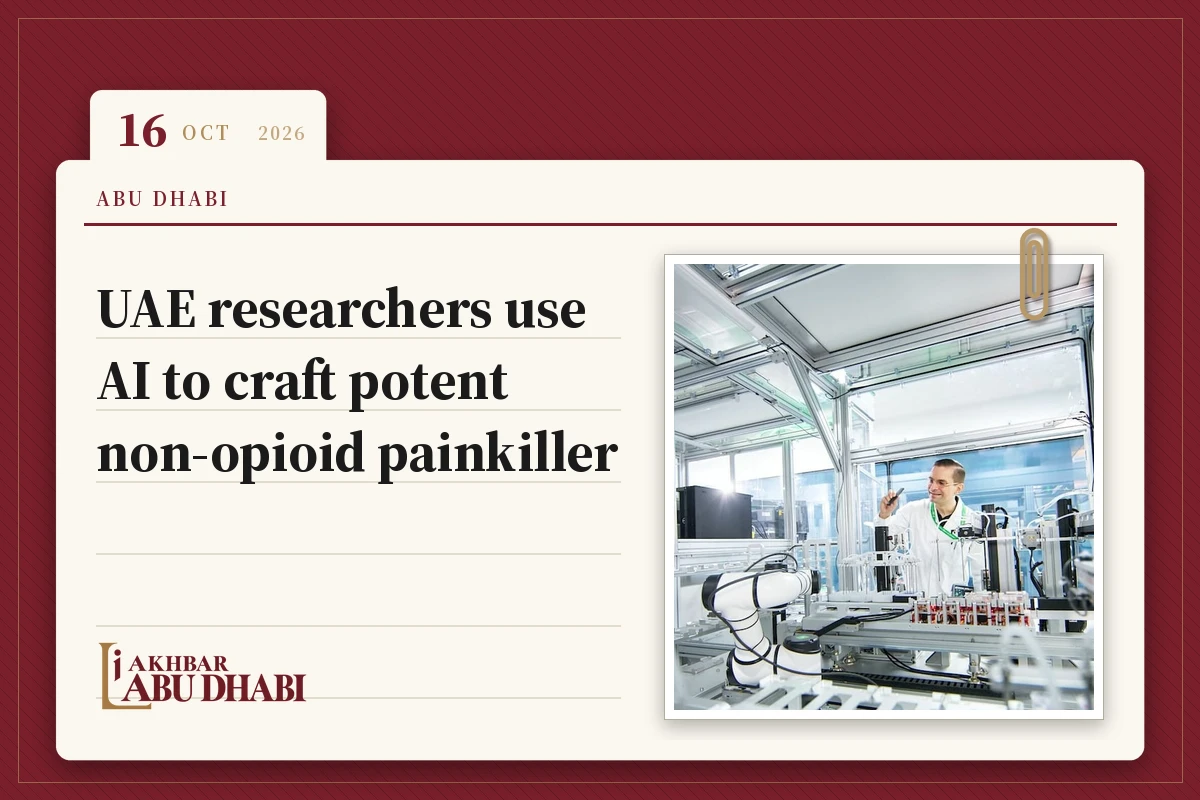
Researchers in the UAE have employed artificial intelligence to create a painkiller they believe could surpass morphine in effectiveness.
AI-driven painkiller development
The molecule, named ISM9528, was devised by Insilico Medicine, a clinical-stage biotech firm whose scientists operate in Abu Dhabi’s Masdar City, aiming to treat both acute and chronic pain.
Initial trials have yielded promising results, and the next phase will involve human testing.
Health experts note that nine out of ten drug candidates that enter human trials fail to gain approval, yet the Insilico team remains optimistic.
“To see a non-opioid candidate outperform morphine in preclinical models is unprecedented,” said Alex Aliper, president and co-founder of Insilico, speaking to The National.
Insilico envisages ISM9528 as an alternative to opioids, which could lower the risk of dependence and addiction.
When questioned about side effects, Aliper remarked the profile was “so far, so good”, adding that tests revealed a “very clean profile on several species in preclinical studies – we will conduct an extensive safety evaluation in further clinical trials”.
The company estimates the global pain‑relief market exceeds $100 billion and stresses the demand for effective non‑addictive therapies.
“If you have a safe, non‑addictive way to treat pain, that’s a game changer,” Aliper said.
Broader pipeline and regional impact
Parallel to the pain project, the Abu Dhabi‑based Insilico team is early‑stage work on a candidate intended to tackle several cancers, notably glioblastoma, an aggressive brain tumour.
The research takes place at Insilico’s AI and drug discovery hub in Masdar City; most of the firm’s AI staff reside in Abu Dhabi, with additional sites in Boston, Montreal, Hong Kong and Shanghai.
“Developing ISM9528, a potential treatment for pain, right here in Abu Dhabi demonstrates how the UAE’s thriving innovation ecosystem has made huge leaps over the past few years,” stated Ahmed Al Suwaidi, Insilico’s associate director of strategic partnerships and business development for the Middle East.
He added that the firm is using “advanced locally based AI capabilities to develop ground‑breaking, real‑world medical solutions that address a critical global health care challenge”.
Insilico’s leaders describe the simultaneous progress on the two drugs as a notable regional milestone, pointing out that novel‑medicine discovery has traditionally been limited to a handful of nations.
They argue that the Abu Dhabi contingent illustrates how the UAE can broaden its drug‑discovery capacity and produce medicines for worldwide use.
Accelerated candidate nomination and outlook
Insilico was launched in 2014 and commenced building its AI platform that same year; the first end‑to‑end AI‑driven system, Pharma.AI, went live in 2020.
The platform enables scientists to pinpoint disease‑related biological mechanisms, choose a target and craft molecules capable of interacting with it, after which the molecules are synthesised and examined in laboratory and preclinical settings.
Insilico reports that, from project kickoff to the nomination of a preclinical candidate, the timeline averages 12 to 18 months, compared with roughly five years in conventional drug discovery.
A preclinical candidate denotes a prospective drug selected for safety testing prior to human trials.
The firm says it is on pace to nominate roughly one candidate per month this year, whereas large pharmaceutical companies typically submit four or five annually.
The National noted this month that Insilico is also pursuing a drug aimed at blood cancer.
Insilico maintains that AI application reduces the number of experimental cycles and sharpens the focus on which molecules to synthesize and test.
“It’s like having a more precise way to model biology and chemistry at your disposal,” Aliper said. “You have an intelligent system designing molecules for you, with your guidance.”
The company estimates that its methodology could cut early‑stage drug‑discovery expenses from tens of millions of dollars to millions.
Aliper added that this could render it more feasible to pursue therapies for rare diseases that have attracted limited investment.
Nevertheless, Insilico cautions that AI does not accelerate the human‑trial phase.
Clinical trials may span about a decade, depending on the indication, and remain subject to regulatory oversight.
“The analogy we use is there is a highway,” Aliper said. “You can overtake cars on the highway, move really fast, but when you reach downtown, that is clinical trials. You need to move with the speed of traffic.”