Business Thursday 15 October 2026
Adnoc credits decade-old contingency plan for sustaining oil output amid Iran war
By Abu Dhabi Desk
Adnoc’s contingency planning and production growth
Adnoc started getting ready for possible major disruptions to energy supplies a decade to fifteen years back, developing contingency plans and backup infrastructure that allowed it to keep oil output steady during the Iran war.
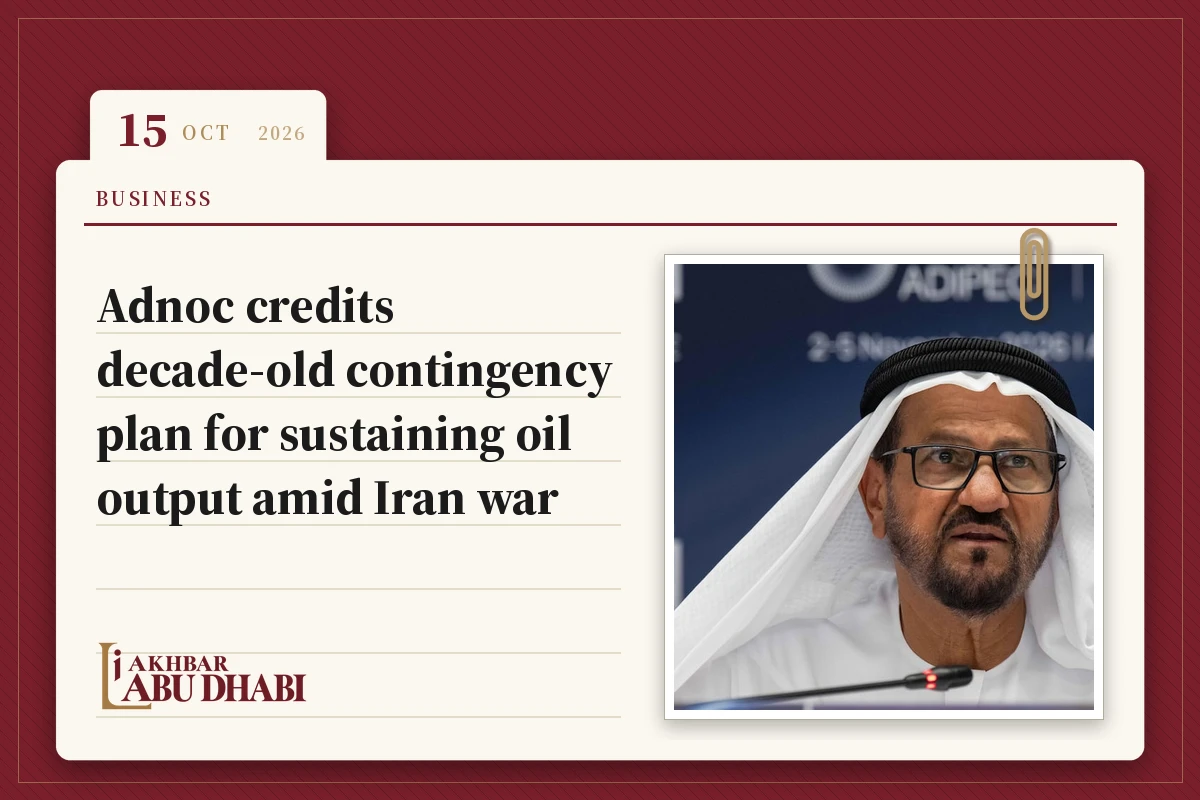
Abdulmunim Al Kindy, a board director at Adnoc and chairman of the Abu Dhabi energy event Adipec, said on Thursday: “We actually prepared for this scenario in our playbooks 10 years ago, 15 years ago.”
Al Kindy, formerly the executive director of Adnoc’s upstream division, noted that the firm had poured significant funds into backup facilities and interconnections, enabling it to change both where it sourced oil and where it delivered it.
He added: “[We] built projects at great expense, even though at the time they didn’t make any commercial sense,” he said. “When the time came, we actually kept the lights on.”
Beyond tangible assets, the readiness included years of emergency drills and scenario planning, which Al Kindy said left staff with an almost muscle‑memory response when the crisis hit.
Over the last ten years, Adnoc has lifted its oil‑production capacity by nearly 75 percent, reaching 4.85 million barrels per day, and aims to push that figure to five million barrels per day by 2027.
In November of the previous year, Adnoc sanctioned a spending plan worth Dh551 billion ($150 billion) for the period 2026‑2030, intended to sustain operations and expand output to keep pace with growing global energy demand.
Adipec 2026 outlook and participation
Speaking at a press briefing ahead of Adipec 2026, which Adnoc will host in Abu Dhabi from 2 to 5 November, Al Kindy said the months of disruption to worldwide oil and gas flows have heightened the urgency of energy security, adding: “2026 has demonstrated a fundamental truth – energy security is economic stability.”
The show is set to attract its biggest Asian turnout ever, featuring 353 companies and six national pavilions for China, India, Japan, Malaysia, Singapore and South Korea.
Organisers anticipate over 239,000 attendees from no fewer than 170 nations, with international guests making up 56 percent of the total, and they predict that three‑quarters of the 2,250 exhibitors will be based outside the UAE.
The agenda will include more than 16,500 delegates and 1,800 speakers spread across 13 programme tracks.
Speakers, deals and economic impact
Thomas Loffler, executive vice president of show organiser dmg events, observed that growing electricity demand from artificial intelligence and industrial expansion is pulling energy security, economic stability and competitiveness into closer alignment.
Strong demand for stand space has led the organisers to shift the opening ceremony to the Abu Dhabi Energy Centre and to enlarge the AI and robotics section of the exhibition.
The confirmed speaker list comprises Suhail Al Mazrouei, UAE Minister of Energy and Infrastructure; Germany’s Minister for Economic Affairs and Energy Katherina Reiche; BP chief executive Meg O’Neill; Occidental Petroleum president and CEO Richard Jackson; Shell chief executive Wael Sawan; and Siemens chief executive Roland Busch.
The previous edition of Adipec yielded $53 billion in business deals from 49,131 transactions – the first occasion the organisers recorded the monetary value of agreements made at the event – and added $420 million to Abu Dhabi’s hospitality and tourism sector, according to Loffler.