Business Thursday 12 November 2026
UAE Economy Shows Resilience Amid Conflict, Investment Minister Says
By Abu Dhabi Desk Updated
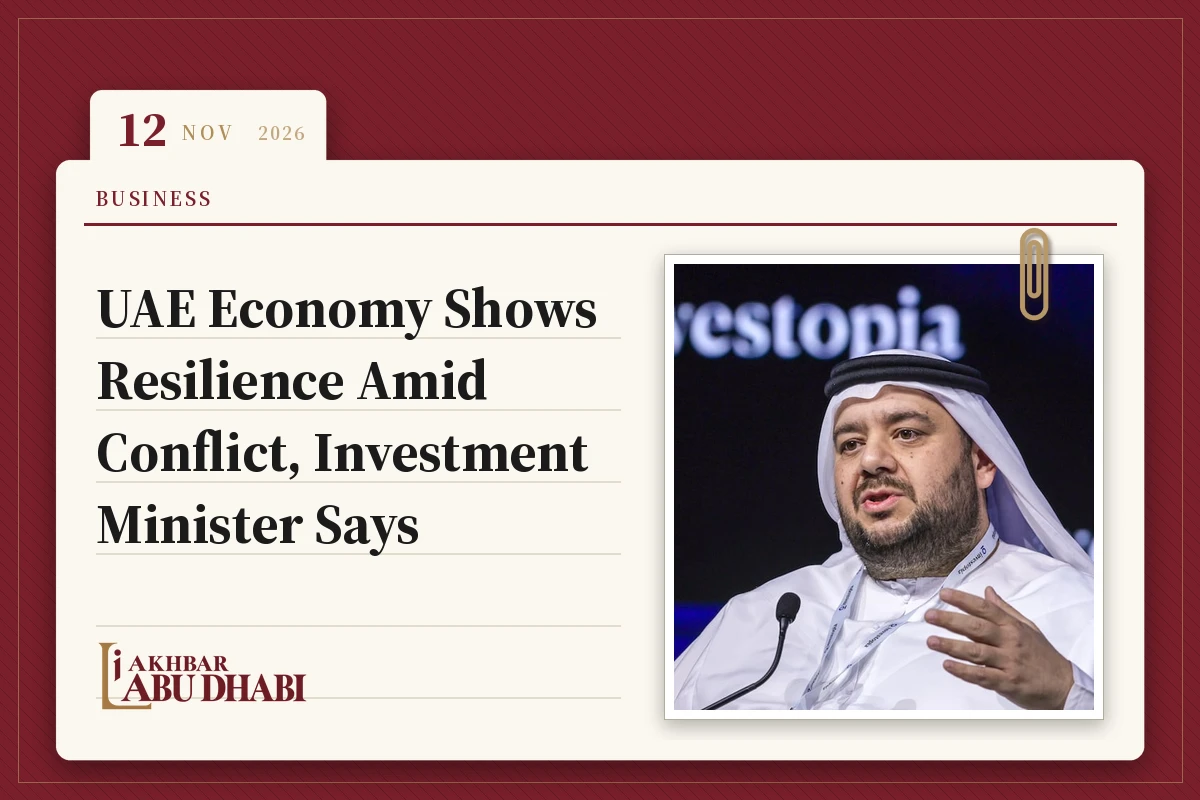
The United Arab Emirates has emerged from the recent conflict in a remarkably strong position, with economic momentum persisting despite uncertainty, according to the country’s investment minister.
Minister Highlights Economic Resilience Amid Conflict
Mohamed Alsuwaidi, Minister of Investment, told Bloomberg Invest on Thursday that the UAE has come through the war “exceptionally well”. He emphasised the need to demonstrate to investors the positive aspects of the situation, noting that opportunity exists in every crisis. The government is examining how to present those opportunities and open sectors previously closed to foreign capital, particularly in infrastructure.
Read also: Adnoc Sour Gas targets sulphur output surge as Hormuz closure reshapes market
The conflict erupted in late February, during which the Emirates faced hundreds of missile and drone strikes that damaged civilian infrastructure and energy facilities. Despite this, real gross domestic product expanded by 0.4 per cent annually to Dh961.9 billion in the first half of 2026, propelled by non-oil business activity.
Read also: Morgan Stanley joins JPMorgan in upgrading UAE equities to overweight on post-conflict recovery
Infrastructure Drive and Financing Plans
Authorities are investing heavily in new pipelines and ports designed to bypass the Strait of Hormuz, while also expanding port capacity on the eastern coast, including at Fujairah. These projects are expected to require billions of dollars. The scale of financing needs was underscored by First Abu Dhabi Bank’s plan to raise as much as Dh15 billion ($4 billion) through the country’s largest rights issue, proceeds from which will support infrastructure expansion and diversification away from oil.
Read also: Etisalat Launches Meta AI Smart Glasses in UAE, Expands Wearable Portfolio
Mr Alsuwaidi said he sees no slowdown in activity, with more opportunities and larger projects materialising. He pointed to booming sectors such as artificial intelligence, logistics and air freight, adding that multiple new areas are opening up and the government must help investors recognise and follow those trends.
Strong Investment Inflows and Growth Data
Foreign direct investment into the UAE increased by about 6 per cent in the previous year to a record $48.24 billion, the ninth highest total globally, according to data from the UN Conference on Trade and Development. The Emirates was also the leading recipient of FDI in the Middle East, ahead of Saudi Arabia which ranked 13th, Unctad said in its World Investment Conference 2026 report released in July.
Read also: Two UAE researchers among six Arab women awarded L'Oreal-Unesco science grants
New Capital Models and Property Market Demand
The minister stated there is no shortage of capital or talent in the country, and the government is moving toward new capital models to fund massive infrastructure requirements. “I don’t see a challenge in the UAE on the funding front. I see opportunity to attract third-party capital in ways we haven’t in the past,” he said. More projects in energy, industry and general infrastructure are being opened to the public through public-private partnerships, government collaborations and privatisation of certain state assets.
Demand in the housing market remains high as people continue to move to the UAE, outpacing supply. “We can’t keep up with the demand, so we keep building,” Mr Alsuwaidi added. Shortages are also evident in segments such as offices and warehouses.
More in Business