Business Thursday 19 November 2026
Adnoc Sour Gas targets sulphur output surge as Hormuz closure reshapes market
By Abu Dhabi Desk Updated
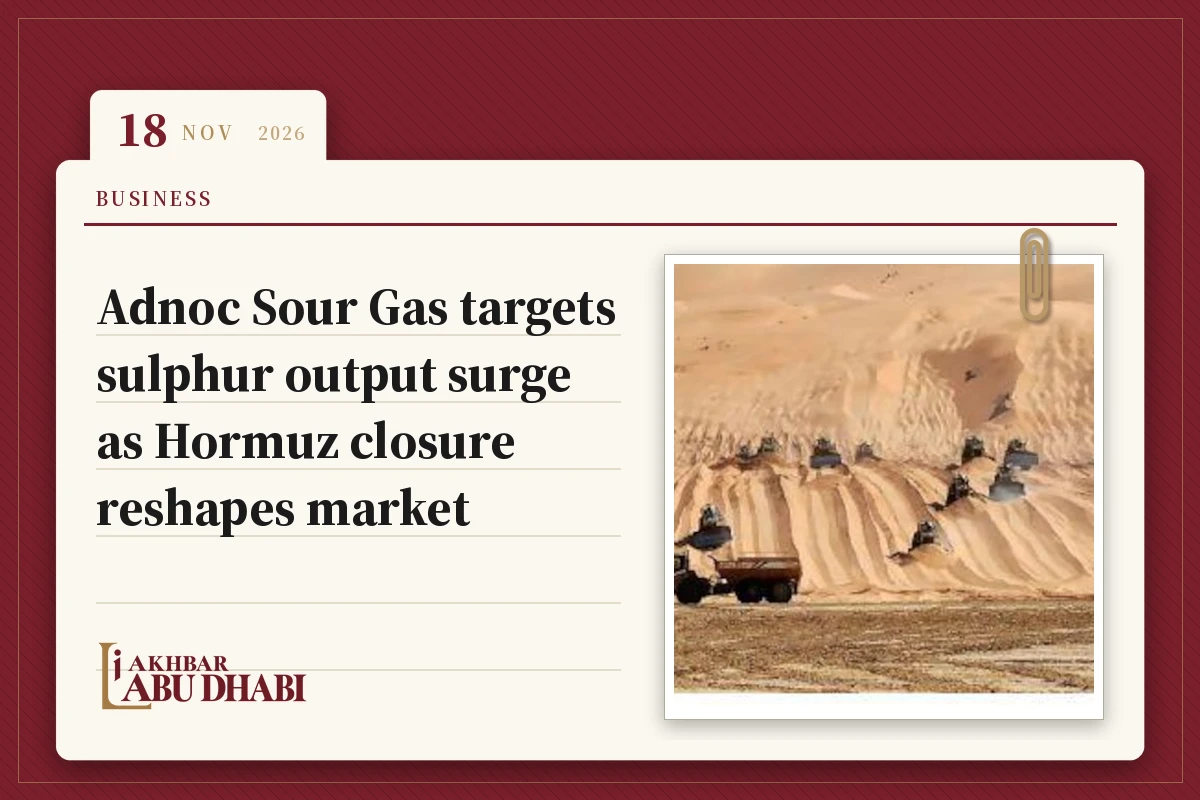
Abu Dhabi National Oil Company’s sour gas division expects its sulphur production to double or even triple over the coming decade, transforming a by-product once treated as a disposal cost into a core revenue stream after the closure of the Strait of Hormuz drove prices to unprecedented levels.
Conference outlines ambitious production goals
Speaking at the Middle East Gas Conference in Dubai on Wednesday, Adnoc Sour Gas chief executive Adel Al Jaberi described sulphur as “the future gold”. The unit currently produces roughly seven million tonnes annually, a figure that could climb to between 14 million and 20 million tonnes as the company expands gas output. Most of the increase is projected between 2030 and 2035, with the final volume contingent on which projects receive final investment approval.
Strait disruption turns overlooked commodity strategic
The shutdown of the vital waterway has recast sulphur as a strategic resource. According to S&P Global, the Gulf region supplies about 47 per cent of global seaborne exports. The disruption pushed free-on-board benchmarks above $1,000 a tonne and delivered prices to roughly $1,200 to $1,300 by July. Sulphur is an essential feedstock for phosphate fertiliser and for the sulphuric acid used in nickel and copper processing.
Read also: UAE President and Timor-Leste leader discuss bilateral cooperation and water security in Abu Dhabi
From negative pricing to record highs
When Adnoc began developing its Shah field 10 to 15 years ago, sulphur traded at minus $8 a tonne because producers had to pay buyers to remove it. “Nobody was thinking about applications at that time,” Al Jaberi said. “That’s the journey of sulphur.” Data from CRU shows prices surged from a pre-conflict average of about $500 a tonne to $1,100-$1,200 in late June. Adnoc set its July official selling price for the Indian subcontinent at a record $1,000 a tonne free on board Ruwais, $180-$200 above the previous peak recorded in 2008, according to Argus.
Prices retreat as buyers step back
Values have since softened as purchasers reduced orders. Adnoc lowered its October price by $70 to $890 a tonne, while spot Middle East prices fell to $740-$790 a tonne by mid-October, Kpler data indicates. The company ships most of its sulphur to China and Morocco for fertiliser production.
Read also: IMF sharply lowers 2026 growth forecasts for Gulf states as Strait of Hormuz remains closed
Research into new applications under way
Adnoc is collaborating with the Adnoc Research Centre and Khalifa University to develop novel uses, including solid-state batteries, advanced fertilisers, cosmetics, cement additives and soil improvement products.
Harder-to-produce gas fields to supply additional volumes
The extra sulphur will come from a push into more challenging gas reservoirs. Adnoc’s upstream division currently produces about 12.5 billion cubic feet per day and targets roughly 17.7 billion in the coming years, requiring development of marginal and sour fields. The Shah gasfield, suspended after a drone attack caused a fire in March, has resumed output at 1.45 billion cubic feet daily, with plans to raise that to 1.85 billion or possibly two billion. Earlier this month, Adnoc took a final investment decision on the Ruwais Diyab unconventional gas development, its first large-scale unconventional gas project.
Read also: Forex broker red flags: warning signs Gulf traders should not ignore
Technology cuts costs and inspection times
Al Jaberi noted that a single sour gas well once cost as much as $50 million. Artificial intelligence-driven reservoir modelling, drones and robots have since reduced both costs and inspection durations. Demand is also emerging from data centres. “Out of 5 megawatts, 1 megawatt at least will go for AI,” he said.
Regional LNG exports seen doubling
Iman Nasseri, senior vice president for Middle East and Asia at FGE NexantECA, told the panel that the region’s liquefied natural gas exports will double to 200 million tonnes within a decade. He cautioned that it would be “naive” to treat every announced data centre as incremental gas demand.
More in Business