Government & Services Saturday 24 October 2026
Rapid containment essential to curb harm from UAE oil spill, experts warn
By Abu Dhabi Desk Updated
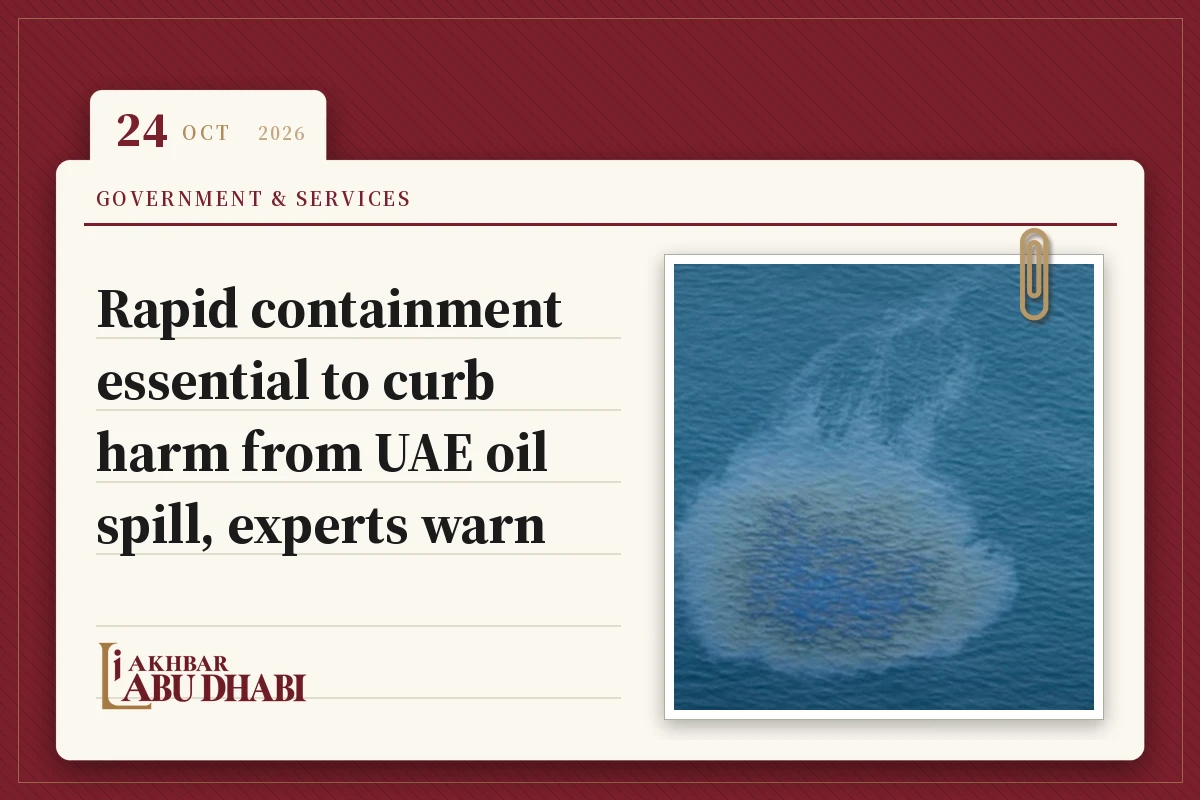
Environmental specialists have emphasised that swiftly containing an oil spill off the coast of Umm Al Quwain is critical to minimising damage to the UAE’s marine ecosystems, following official confirmation of the incident.
The Ministry of Climate Change and Environment verified the spill on Friday after residents across Dubai and the Northern Emirates reported a strong fuel-like odour earlier in the week.
Immediate containment measures
Rob Mortimer, chief executive of Dubai-based Fuelre4m, a supplier of substances used to break up oil slicks, said the first step should be to “keep it all together” using floating barriers known as booms. This allows as much oil as possible to be recovered from the water’s surface.
“It’s reasonably easy to do it while it’s all together,” Mortimer explained. “Once it’s spreading and moving around, it’s more difficult. Even with the dispersant, you have to cover a greater distance … The longer you leave it, the more the oil gets dispersed.”
Another early response, he said, involves dispersants — chemicals that break oil into tiny droplets. These droplets are then more easily broken down by naturally occurring microorganisms into simple compounds such as carbon dioxide, water and harmless by-products.
However, using dispersants requires careful evaluation because some formulations can harm marine organisms, including corals, fish, crustaceans and plankton.
Read also: UAE teachers can tutor legally with permit; visa cancellation possible when employer disappears
“You have got to look at how toxic these dispersants are themselves,” Mortimer said. “Some of the chemicals that are used, they’re not very nice. You have to weigh up whether the treatment is better. Sometimes it’s quite marginal.”
Shoreline risks and clean-up challenges
A key priority when managing oil slicks is preventing pollution from reaching the coast, as shoreline clean-up is far more difficult and habitats can suffer long-term damage.
“Once it hits the shoreline, you have to do a lot of clean-up and remediation,” Mortimer said.
Professor Richard Thompson, director of the Marine Institute at the University of Plymouth, noted that cleaning a wide, sandy beach is typically less complex than dealing with a rocky shoreline. “If you have intertidal habitats with a large range of organisms, it’s going to make it more difficult to clean than if you can capture it at the sea surface,” he said. “If it’s among rocks or mangroves or seagrass, it’s going to be very difficult to clean … Ideally what you’re trying to do is catch it before you get the encounters between the creatures and the oil.”
The US National Oceanic and Atmospheric Administration has highlighted the trade-offs involved in using dispersants, balancing the benefit of removing oil from the sea surface and reducing shoreline contamination against potential impacts on plankton and other organisms in the water column. “Part of the work of planning the response to potential oil spills is the difficult task of evaluating these trade-offs, which requires careful consideration of the resources and issues involved,” the agency stated in an online briefing document.
Read also: UAE Pushes AI in Health and Education While Stressing Cybersecurity Safeguards
Mortimer said Fuelre4m supplies vegetable-based dispersants and is seeking approval from UAE authorities to deploy them.
The risks of some oil-spill treatment chemicals were highlighted after the Torrey Canyon tanker ran aground off south-west England in 1967 while transporting oil from Kuwait to Wales. Some of the dispersants used at that time were reported to be more toxic to marine life than the oil itself.
Official response and wider context
Umm Al Quwain Municipality announced on Friday that it was working to contain the pollution and reduce harm to marine and coastal environments. The source of the oil has not been officially confirmed.
This spill is the latest in a series of incidents that have raised concern about the “unprecedented” environmental consequences of this year’s US-Iran war.
In response, beaches and coastal areas in Umm Al Quwain were closed, and Sharjah’s Al Hamriya Beach was also shut.
Read also: UAE performs first corneal transplant using locally sourced donor tissue
Inesaf Benzaki, campaigns lead at Greenpeace Mena, said timely containment is particularly important because the Gulf’s semi-enclosed geography limits water exchange with the open ocean, allowing pollutants to persist. “We acknowledge the UAE authorities’ ongoing efforts to contain the reported oil spill off Umm Al Quwain and address its immediate effects,” she said. “As these efforts continue, understanding the potential environmental impact will be important to protecting the area’s marine ecosystems.”
Benzaki noted that the coastline is part of a broader marine environment where shallow waters, mangroves, seagrass meadows and lagoons provide essential habitats for marine life and support coastal livelihoods. She warned that even after visible oil is removed, residues can remain in coastal sediments and sensitive habitats, prolonging the spill’s effects. If oil reaches the UAE coastline, it could “threaten sensitive marine and coastal ecosystems,” she said.
Continued environmental monitoring and assessment, she added, would help determine the extent of damage, identify areas needing further attention and guide recovery measures. Protecting these ecosystems matters not only for marine biodiversity but also for coastal communities that depend on healthy seas.
Professor John Burt, director of New York University Abu Dhabi’s Mubadala Arabian Centre for Climate and Environmental Sciences, has previously warned that if oil reaches the coastline, remediation could be costly and full recovery could take years. During the 1990-91 Gulf War, millions of barrels of oil were released into the northern Arabian Gulf. Burt said submerged habitats such as coral reefs and seagrass beds were not as severely affected in some areas because oil generally floats. However, coastal areas in the northern Gulf that oil reached suffered considerable damage, with mangroves and mudflats used by feeding birds among the affected habitats, and footage from the period showed birds covered in oil.
The latest incident has renewed attention on the importance of rapid containment, careful selection of clean-up methods and sustained environmental monitoring to limit potential damage to the Gulf’s marine and coastal ecosystems.