Government & Services Wednesday 14 October 2026
‘Sick with grief’: Families of two missing Indian sailors wait for news after drone strike off Oman
By Abu Dhabi Desk Updated
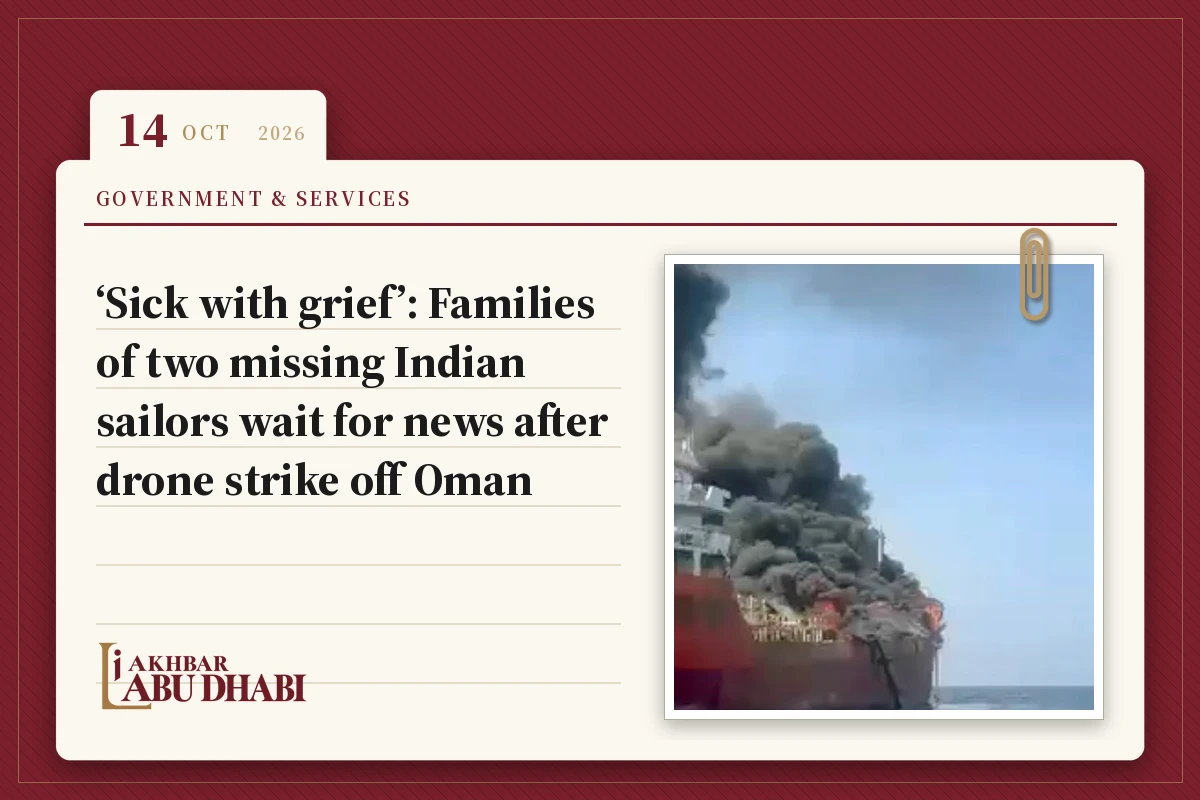
Two families in northern India are grappling with the loss of two young sailors who have been missing since a drone struck an empty oil tanker near the Omani port of Sohar on Sunday. Relatives of Amit Singh, 20, and Bir Bahadur Yadav, 25, say they are consumed by grief as they await any news.
The MT Petro Dolphin, a Nicaraguan-flagged tanker, was hit while at anchor off Sohar. According to India’s External Affairs Ministry, nine Indian nationals and one Bangladeshi crew member were rescued from the 12-person crew, but two seafarers remain unaccounted for. Both missing men were on their first sailing assignment.
Grief and shattered dreams
“Amit’s parents are in and out of consciousness, they cannot cope. It’s all finished, there are no dreams left, it’s all broken,” said Ravindar Singh, Amit’s uncle, speaking from Gopala village in Uttar Pradesh. “It’s as if they are dead. As long as they live, they will be in this condition, like death. We are trying to support them but what can we say to comfort them?”
Ravindar Singh, an experienced seafarer of 20 years, spoke to rescued crew members to learn where his nephew was when the drone struck. “The men told me Amit was working on the main deck in the exact same place of the drone attack. We know he is no more,” he said. “The crew were evacuated by fishermen. They went around the vessel to search in case the sailors had jumped into the sea, but found nothing.”
Video recorded by the crew shows fire and smoke engulfing parts of the tanker, and a sailor can be heard crying out: “My two crew have gone, Allah, my two men have died.”
Amit Singh came from a poor farming community and had followed his uncle into the merchant navy. He signed on with the tanker in January as an able seaman, handling navigation, mooring, cargo and deck maintenance. His uncle had returned home in May after a projectile landed near his ship in the Black Sea. Amit was due to complete his contract on 20 October, and the two had planned to find a safe voyage together.
“Amit was excited about coming home,” Mr Singh said. “After the Iran war, it is the worst condition for sailors. But Amit’s vessel was not in the Strait of Hormuz, it was in anchorage. How can it be that sailors are not safe near the port?”
He described his nephew’s ambitions: “Amit was starting out in life. He wanted to save money to get his older sister married. His parents live on a small farm and he wanted a better life for them. This is so wrong. Why should Amit be gone? We are just seamen. We are like drivers, we load and unload cargo, we do as we are told. But they are targeting us. If the ship is the target, at least give sailors a warning. Property damage can be fixed but a sailor’s life is gone.”
Someone’s son, someone’s brother
The family of the second missing sailor, Bir Bahadur Yadav, also from Uttar Pradesh, tried to keep the news from his mother, but she learned from villagers who had seen reports on television. “I didn’t want to tell my mother until we were sure but now she knows, her spirit is broken. She is constantly crying,” said Mantoo Yadav, Bir’s elder brother, who works in Abu Dhabi and was visiting home when the attack occurred. “In this war, why are sailors being killed? It is someone’s son, someone’s husband, someone’s brother who is dying. What will you get from killing our brothers?”
The night before the drone strike, Bir Bahadur spoke to his family about wanting to come home. The youngest of four siblings, he worked as a wiper, cleaning the engine room and machinery, with four months left on a nine-month contract. “We had a long talk. He told us he had seen attacks and saw one ship hit nearby,” Mr Yadav said. “Bir was worried his ship would become a target. But he thought he should stay and finish the contract. We told him to come home but it was too late.”
Mantoo Yadav, 36, said his younger brother was focused on completing seafarer certifications to earn a higher rank. “Bir wanted to work hard, finish exams to get a good position. He was serious when he spoke but could also make people laugh. He was very loving.”
The family still holds onto a sliver of hope. “We have been told that we will know about Bir only when the ship is brought to shore and checked,” Mr Yadav said. “The crew saw the attack and know the other sailor is no more. But the crew did not see Bir. What if he managed to jump off? There is 10 per cent hope that he is still alive. Maybe in the rescue, they will find him unconscious.”
Waiting for news and calls for protection
Manoj Yadav, general secretary of the Forward Seamen’s Union of India, described the trauma families endure while search operations continue. “It’s tough. When a vessel is hit by drone or rocket, there is fire and waterlogging. It takes time to search the area for missing sailors, and families may not get an answer for days,” he said.
Neither Iran nor the United States has claimed responsibility for the drone strike. Maritime associations have urged stronger protections for seafarers as the conflict persists. “This tanker was anchored off Sohar, so what was the need to hit this vessel? The only danger is for sailors,” Mr Yadav said. “It’s a very alarming situation and the threat to sailors is growing. Families are suffering. We need strong measures to protect seafarers.”
According to maritime agency reports, at least 12 tankers have been attacked in the Arabian Gulf and Strait of Hormuz in the past week as Iran intensifies its campaign to disrupt US-backed oil movements. The International Maritime Organisation has recorded 24 seafarer deaths and 104 incidents in the Strait of Hormuz and the Middle East since the Iran war began on 28 February.
India’s External Affairs Ministry has condemned the attacks. “The recurring attacks on commercial shipping in the region are deeply concerning and risk further aggravating an already volatile situation,” the Indian government said. “Attacks on commercial vessels, seafarers and civilian infrastructure must cease.”