Business Wednesday 14 October 2026
Chinese robotics firms look to Gulf for manufacturing ties as physical AI emerges
By Abu Dhabi Desk Updated
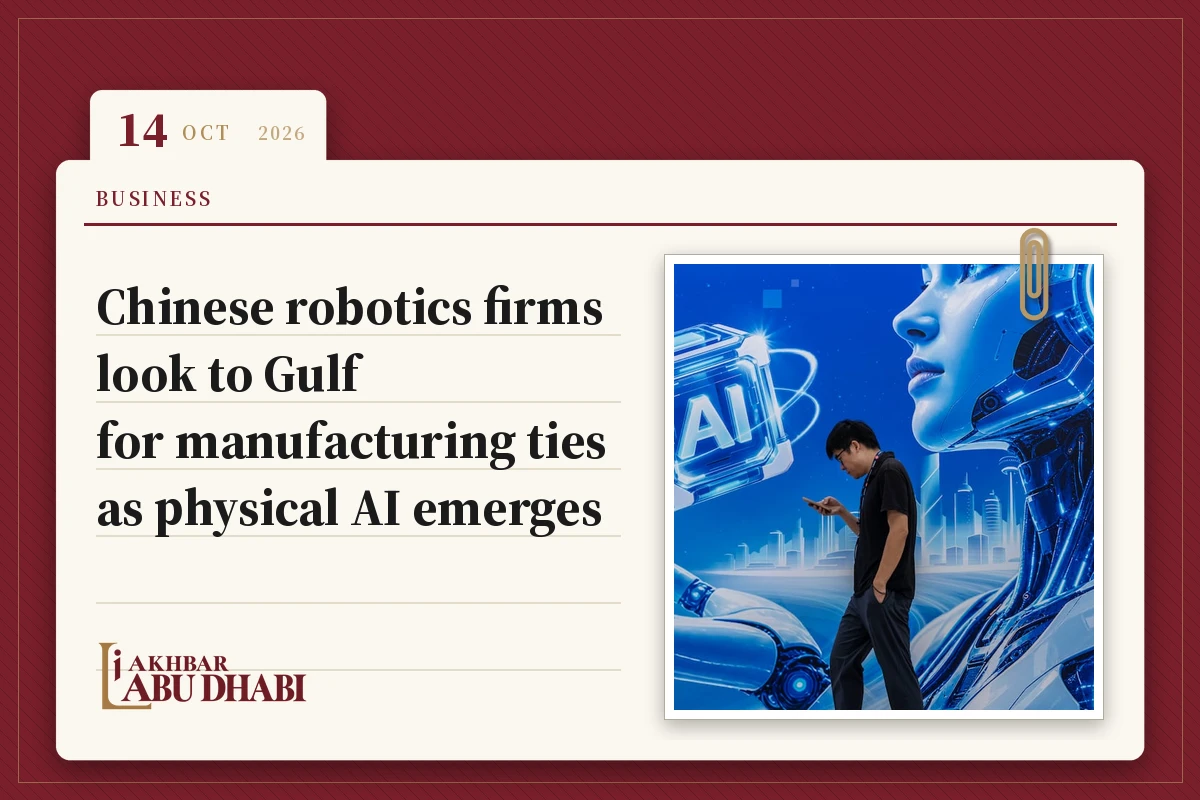
Chinese robotics firms are exploring the Gulf as a potential hub for manufacturing the next generation of AI‑driven machines, attracted by the region’s financial resources, energy supplies and industrial ambitions.
Beijing‑based LinkerBot, represented by vice president and head of global markets Weber Su, said at the AIM Summit in Dubai that it is in talks with major UAE institutions about possible partnerships.
Gulf partnerships for robotics manufacturing
One model under discussion would have Chinese suppliers provide advanced robotic components while the UAE handles capital‑intensive assembly and automated production.
Such an arrangement would let Gulf states participate directly in building sophisticated robots instead of mainly importing the technology.
Weber Su said that could be the business model being explored with Middle Eastern countries, especially the UAE.
LinkerBot focuses on dexterous robotic hands that enable machines to grasp and manipulate objects, and has broadened its portfolio to include reducers and micromotors that control movement.
Physical AI and its applications
The talks reflect a wider trend where Asian firms look for overseas manufacturing partners while Gulf states use their capital, energy and infrastructure to develop higher‑value industries.
In September, Chinese electric and extended‑range vehicle maker ROX Motor started vehicle production in Abu Dhabi.
The UAE is expanding manufacturing under its Operation 300bn strategy, which aims to raise the industrial sector’s contribution to gross domestic product to Dh300 billion by 2031.
According to the Ministry of Industry and Advanced Technology, the country’s industrial exports grew 25 % last year to a record Dh262 billion, with medium and high‑technology exports up 42 % to Dh92 billion.
The UAE is also investing in automation to boost manufacturing competitiveness.
Weber Su added that Chinese companies could concentrate on specialised robotic parts while Gulf partners develop the capital‑intensive assembly needed to bring those technologies to market.
Turning these discussions into successful commercial ventures will require investment agreements, viable production models and steady demand for AI‑powered machines.
The potential collaborations emerge as the tech sector shifts toward what investors and developers call the next stage of artificial intelligence – physical AI.
Chinese AI developers such as DeepSeek, Zhipu AI and Moonshot AI are becoming increasingly competitive with US rivals, offering advanced models at lower costs, said Joseph Zeng, founder and chief investment officer of Hong Kong‑based Arcadia Fund Management Group.
While generative AI has centred on chatbots, content creation and software applications, the forthcoming phase is expected to place intelligent systems in the physical world.
Physical AI combines sophisticated AI models with robotics, enabling machines to interpret their surroundings, make decisions and perform tasks that usually need human intervention.
Unlike conventional industrial robots that are programmed for repetitive motions, the goal is to create machines that can adapt to changing situations.
Possible uses include robotic hands handling unfamiliar objects, autonomous machines moving along production lines and robots assisting hospital patients.
Weber Su noted that advances in computing power and AI models are making these capabilities increasingly feasible.
LinkerBot is developing robotic hands with built‑in movement ability that could later be paired with advanced AI systems to widen the range of tasks they can perform.
He said, “We’re going to have skill stores similar to the app stores.”
China’s manufacturing scale could give its firms an edge as the technology moves toward commercial production.
The country installed about 295,000 industrial robots in 2024, representing 54 % of global installations, according to the International Federation of Robotics.
The figures pertain to factory robots rather than humanoids, but they illustrate the scale of China’s industrial automation sector and its supply chains.
SK hynix held 50 % of the global high‑bandwidth memory market by revenue in the second quarter of 2026, while Samsung accounted for 33 %, according to Counterpoint Research data reported by the Yonhap news agency.
Broader investment and energy implications
Beyond robotics, physical AI offers many opportunities for investors, said Joseph Zeng, whose portfolio includes ByteDance and Zhipu AI in China as well as South Korea’s SK hynix and Samsung.
He added that the next AI stage will require progress in computing hardware and infrastructure.
He identified high‑bandwidth memory, optical transceivers and robotics components as technologies attracting rising investment, and noted that health care could also become a significant market.
During a recent visit to Suzhou, near Shanghai, Joseph Zeng said he saw a company developing a voice‑controlled robot designed to help bedridden patients with repositioning and personal care.
Weber Su said humanoid robots might eventually assist in caring for elderly people and children in smaller communities where shrinking populations make it hard to recruit doctors and maintain health services.
Although fully autonomous, general‑purpose robots are still under development, their potential to ease labour shortages, cut care costs and extend essential services to underserved areas shows the social and economic impact physical AI could have outside factories.
For the Gulf, opportunities could involve deploying autonomous systems in existing industries.
Joseph Zeng highlighted electric and autonomous heavy‑duty trucks for mining and industrial operations, together with energy storage and cleaner power technologies.
Energy is also growing in importance for AI investment.
Global data‑centre electricity consumption is expected to more than double to about 945 terawatt‑hours by 2030, according to the International Energy Agency.
The forecast underscores the need for electricity generation, storage and cooling infrastructure as AI adoption accelerates.
For Gulf countries with ample energy resources and expanding renewable power capacity, this creates another possible area of collaboration with Asian technology developers.